


For many years, modern football has placed greater emphasis on creating high-quality chances inside the penalty area. Teams have increasingly focused on patient build-up play, accurate passing and finding space close to goal rather than taking speculative shots from distance.
However, this trend appears to be changing.
Across European football, long-range shooting has become an increasingly important part of attacking play. Some of the continent’s leading teams are taking more shots from outside the penalty area, using different tactical approaches to create opportunities that were previously difficult to find.
But why are teams shooting from distance more frequently? And are these attempts actually helping them score more goals?
Two important tactical developments help explain this change: aggressive high pressing and the growing importance of compact low blocks.
1. The Rise of Long-Range Shooting
Long-range shots were once a regular feature of football, but modern tactical approaches gradually encouraged teams to focus on creating better opportunities closer to goal.
The development of organised defensive systems made shooting from distance less attractive. Defenders became better at closing down space, blocking shooting lanes and forcing attackers into less favourable positions.
However, modern football has introduced new situations in which players can find more space outside the penalty area.
Some of Europe’s leading clubs, including Bayern Munich, Barcelona and Paris Saint-Germain, have demonstrated how quickly teams can create shooting opportunities from distance through pressing, quick transitions and positional rotations.
This is not simply about players deciding to shoot more often. It is also a consequence of how modern teams attack and defend.
2. How High Pressing Creates Long-Range Shooting Opportunities

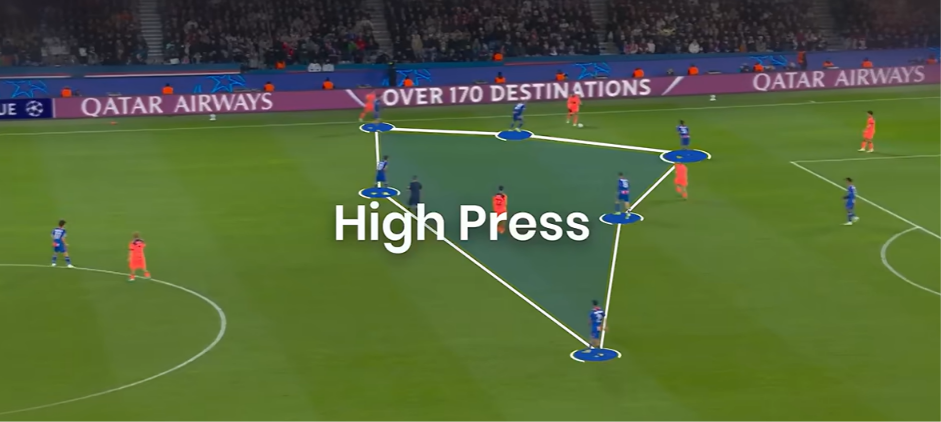
One of the biggest tactical changes in modern football is the increased use of aggressive high pressing.
Teams now put significant pressure on opponents during the build-up phase, often using man-oriented pressing systems to prevent defenders and midfielders from progressing the ball comfortably.
This approach creates a high-risk environment.
When a team successfully wins possession, it can immediately launch a dangerous counterattack. However, when the pressing team is bypassed, large spaces can appear behind its midfield.
These situations often leave defenders moving backwards towards their own goal, creating valuable space in front of the defensive line.
Space Before the Defence Can Recover

After winning possession or breaking through the opposition’s first pressing line, attackers can quickly move into open areas.
The defending team may still have several players recovering their positions, making it difficult to protect every area around the penalty box.
As defenders retreat, the space just outside the box can become available.
Instead of waiting for another passing opportunity, an attacking midfielder or forward may have enough time to take a shot from distance.
Brighton, Bayern Munich and Paris Saint-Germain provide examples of teams capable of exploiting these situations through quick transitions and aggressive attacking movements.
What Happens When the High Press Fails?

There is another side to aggressive pressing.
When a team commits several players forward to win the ball, an opponent that successfully escapes the pressure can attack the space left behind.
The midfield can become bypassed, forcing defenders to turn and recover towards their own goal.
During this moment of defensive disorder, an attacker may receive the ball outside the penalty area with enough time to shoot.
The important factor is timing. The opportunity often disappears once the defending team reorganises its defensive structure.
3. Low Blocks Are Creating More Space Outside the Box
The second major tactical reason behind the increase in long-range shooting is the growing importance of the low block.
A low block is a defensive strategy in which a team positions most of its players close to its own penalty area, reducing the space available for attackers to move into dangerous central areas.
This approach can be extremely difficult to break down.
Defenders remain compact, midfielders protect the spaces between the lines and the entire defensive unit moves together to close passing channels.
As a result, attacking teams often struggle to find opportunities inside the penalty area.
Why Low Blocks Encourage Long-Range Attempts
Against a compact defensive structure, teams frequently circulate possession from one side of the pitch to the other.
They attempt to move defenders out of position, create overloads and find gaps between defensive lines.
However, modern low blocks are increasingly flexible. Teams can shift their defensive shape, cover half-spaces and block crosses before the ball reaches dangerous areas.
This makes traditional attacking approaches less effective.
One possible solution is to create opportunities around the edge of the penalty area.
By committing more players forward and moving the ball quickly, attacking teams can force the opposition’s midfield line deeper.
This can create a small pocket of space outside the box for a midfielder or winger to shoot.
In these situations, long-range attempts become a tactical alternative rather than simply a desperate option.
4. How Bayern Munich and Barcelona Exploit These Spaces

Bayern Munich have demonstrated how positional rotations and quick combinations can help create shooting opportunities against compact defensive structures.
Rather than keeping every attacking player wide, their wingers can move into more central positions.
This creates numerical overloads in central areas and gives the team more options around the edge of the penalty area.
Players can exchange quick passes, attract defenders and create a shooting opportunity before the defensive structure has time to adjust.
Barcelona can also use quick switches of play to move the opposition’s defensive block from one side to the other.
When the ball reaches a player in space outside the penalty area, there may be an opportunity to finish the attacking move with a long-range effort.
These examples show that successful long-range shooting is often connected to collective attacking movements rather than individual shooting ability alone.
5. Are Long-Range Shots Actually More Effective?
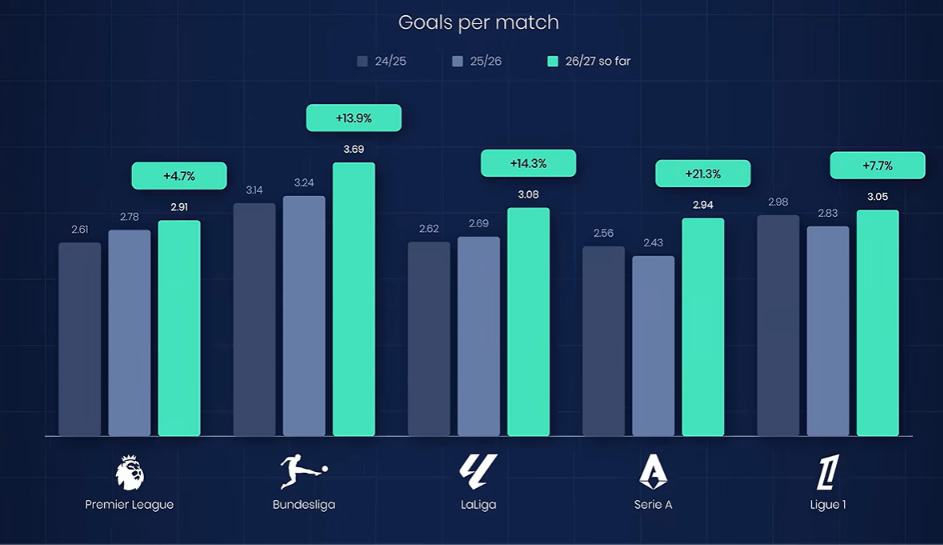
An increase in long-range attempts does not automatically mean an increase in goals.
This is where Expected Goals (xG) becomes particularly useful.
Expected Goals estimates the probability of a shot resulting in a goal based on factors such as shooting distance, angle and other characteristics of the chance.
In general, shots from outside the penalty area have a lower xG value than clear opportunities created close to goal.
For example, a well-positioned shot from inside the penalty area may have a much higher probability of becoming a goal than an attempt from 25 metres.
This explains why defensive teams may sometimes allow opponents to shoot from distance rather than leave dangerous spaces open closer to goal.
However, long-range attempts can still be valuable when the attacking team has players with excellent shooting ability.
A powerful or accurately placed effort can punish defenders who give the opposition too much time and space.
The challenge for managers is finding the right balance between taking available shots and continuing to search for higher-quality opportunities.
6. Why Some Top Teams Shoot Less From Distance
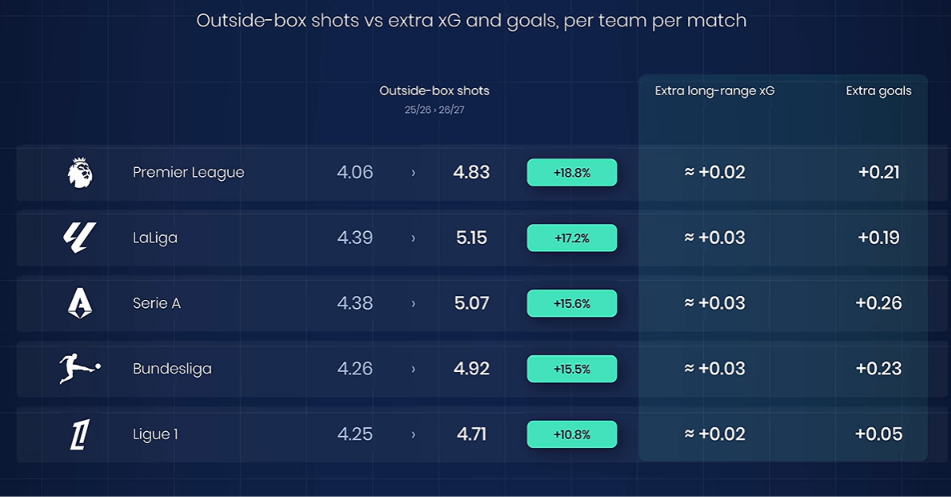
Not every successful team follows the same attacking approach.
Manchester City, Arsenal and Real Madrid provide examples of clubs whose attacking characteristics can lead to different shooting patterns.
Manchester City can build attacks around a central striker such as Erling Haaland, prioritising deliveries and opportunities inside the penalty area.
Arsenal’s shooting numbers can also reflect changes in their overall chance creation. When a team creates fewer opportunities in general, long-range attempts may decrease as part of a wider attacking trend.
Real Madrid, meanwhile, can use more direct and vertical attacking movements to reach dangerous areas without necessarily relying on repeated attempts from outside the box.
These differences highlight an important point: there is no single attacking formula that works for every team.
The best approach depends on the players available, the opponent’s defensive structure and the spaces created during a match.
7. What Does the Future Hold for Long-Range Shooting?
Long-range shooting is likely to remain an important part of modern attacking football as tactical systems continue to evolve.
Aggressive pressing can create open spaces during transitions, while compact low blocks can encourage attacking teams to explore opportunities around the edge of the penalty area.
However, teams will continue adapting.
Defenders may step out more aggressively to close down shooters, while managers could introduce new positional structures to protect the space outside the box.
The balance between creating high-quality chances and taking advantage of available shooting opportunities will remain an important part of tactical planning.
Ultimately, long-range shooting is not necessarily replacing traditional attacking football. It is becoming another tool that teams can use to solve different defensive problems.
Frequently Asked Questions
Why are football teams taking more long-range shots?
Two important tactical factors are aggressive high pressing and compact low blocks. Both can create situations in which attacking players find space outside the penalty area.
What is a low block in football?
A low block is a defensive approach in which a team positions most of its players close to its own goal to reduce space and make it difficult for opponents to create chances.
How does high pressing create shooting opportunities?
When a team wins possession or breaks through an opponent’s press, the defending team may not have enough time to recover its defensive positions. This can leave space in front of the defence for long-range attempts.
Do long-range shots have a high Expected Goals value?
Generally, long-range attempts have lower Expected Goals values than clear chances created closer to goal. However, the quality of the shooter and the specific circumstances of the attempt can make a difference.
Which teams use long-range shooting effectively?
Teams such as Bayern Munich, Barcelona and Paris Saint-Germain have demonstrated different ways of creating long-range opportunities through pressing, quick transitions and positional combinations.
Final Thoughts
The return of long-range shooting reflects the changing tactical landscape of modern football.
High pressing creates opportunities during transitions, while low blocks can leave attacking teams searching for alternative ways to reach the goal.
Although shooting from distance does not guarantee more goals, it gives teams another attacking option when traditional approaches become difficult.
Modern football is becoming increasingly tactical, and the ability to recognise and exploit space outside the penalty area could remain an important advantage for the best attacking teams.