
Football has always been a game of instinct, tactics and split-second decisions.
But behind every modern team, there is another game happening at the same time: the game of data.
Today, football clubs can track how far players run, how fast they sprint, where they move on the pitch, how often they accelerate and decelerate, and how their physical output changes from one match to another.
The newest generation of AI performance tracking systems takes this even further by combining GPS, wearable sensors, video analysis, computer vision and artificial intelligence.
Instead of simply collecting statistics, these systems can help coaches understand what the numbers actually mean.
What Are AI Performance Tracking Systems?
AI performance tracking systems are technologies designed to collect and analyse information about an athlete’s physical and tactical performance.
In football, the technology can use:
- GPS and GNSS trackers
- Wearable sensors
- Heart-rate monitors
- Match cameras
- Computer vision
- Machine learning
- Player-position data
- Historical performance data
- Heat maps and tactical models
Electronic performance and tracking systems are already widely used across team sports to measure athlete location and velocity, monitor workloads and analyse physical and tactical behaviour.
The difference with AI is that software can process enormous amounts of information and identify patterns that would take humans much longer to find.
How Does AI Performance Tracking Work?

A typical system has several stages.
1. Data Collection
Everything starts with data.
A football player may wear a small GPS/GNSS device positioned inside a performance vest. Other systems can use cameras placed around the stadium or training ground.
Video-based systems can also track players without requiring them to wear a tracking device.
2. Data Processing
Raw tracking data contains thousands of individual measurements.
The software converts those measurements into understandable statistics such as:
| Metric | What It Shows |
|---|---|
| Total Distance | Overall running volume |
| Maximum Speed | Fastest movement |
| Sprint Distance | High-intensity running |
| Acceleration | Explosive movement |
| Deceleration | Braking workload |
| Player Load | Physical demand |
| Heat Map | Areas occupied on the pitch |
| Position | Movement and tactical location |
3. Pattern Detection
This is where artificial intelligence becomes particularly useful.
Instead of looking at one match, AI can compare data across multiple sessions.
For example, a midfielder might cover roughly the same total distance as usual but produce considerably less high-speed running.
That does not automatically mean the player is tired. Tactical instructions, match circumstances and the opposition can all affect the numbers.
But it gives the performance team a pattern worth investigating.
4. Turning Data Into Decisions
The final goal is not another spreadsheet.
It is a decision.
Coaches can use tracking information to adjust training, evaluate workload, analyse positioning and compare current performances with previous matches.
AI Performance Tracking in Football
Football is particularly well suited to tracking technology because players are constantly moving through a large tactical environment.

Modern optical tracking systems can follow players and the ball and turn their movement into physical and tactical information. Some newer platforms can extract tracking data directly from existing match video without requiring GPS wearables or stadium hardware.
This creates an important distinction:
Traditional statistics tell you what happened.
AI tracking can help explain how and where it happened.
GPS and Wearable Tracking
GPS and GNSS devices remain an important part of athlete monitoring.
A player can wear a small tracker during training or matches, allowing the system to record movement throughout the session.
Depending on the system, coaches can monitor:
- Distance covered
- Maximum speed
- Sprint distance
- Acceleration
- Deceleration
- High-speed running
- Movement intensity
- Workload
These measurements become much more useful when compared with the player’s previous performances.
Example: A Midfielder
Imagine a midfielder produces the following numbers:
| Metric | Match Result |
|---|---|
| Distance | 11.4 km |
| Maximum Speed | 31.2 km/h |
| Sprint Distance | 640 m |
| Accelerations | 52 |
| Decelerations | 45 |
| High-Speed Running | 1.8 km |
On their own, these numbers tell us something.
But an AI system can compare them against the player’s normal range and recent matches.
That is where the analysis becomes much more valuable.
Computer Vision Can Track Players From Video
GPS is not the only way to collect performance data.
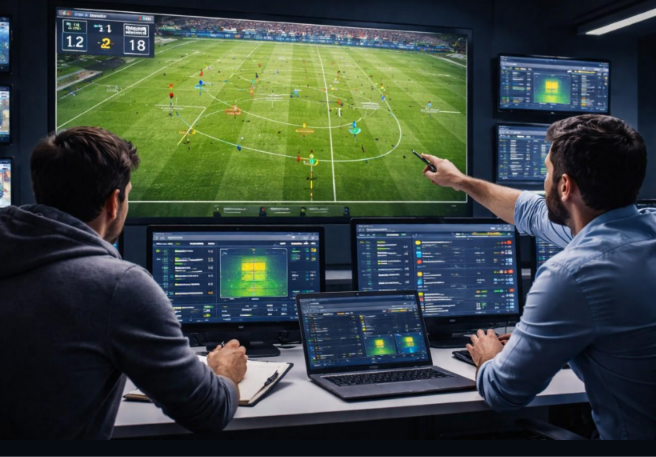
Artificial intelligence can now analyse football video and track players directly from the footage.
Computer-vision systems can identify players, follow their positions and calculate movement information.

A 2026 study tested commercially available computer-vision and AI player-tracking systems using broadcast footage from a 2022 FIFA World Cup match. The researchers found that accuracy varied considerably between providers, with player detection and the type of camera feed having an important influence on results.
This is important because AI tracking is powerful, but the quality of the input still matters.
A tactical wide-angle camera can give an AI system a much better view of the entire pitch than footage constantly switching between close-up broadcast angles.
AI Tracking Without Wearables
One of the most interesting developments is the ability to extract performance information from ordinary match footage.
Newer computer-vision platforms claim to track players, the ball and referees from a single video feed, generating information about positioning, movement and tactical behaviour without GPS devices.
This could be particularly important for:
- Amateur clubs
- Youth academies
- Women’s teams
- Lower-division clubs
- Scouting departments
- Smaller football organisations
Research published in 2026 also explored using object detection and tracking models to extract player-level spatial information from standard broadcast footage, potentially reducing dependence on expensive tracking hardware.
Heat Maps: Turning Movement Into a Picture
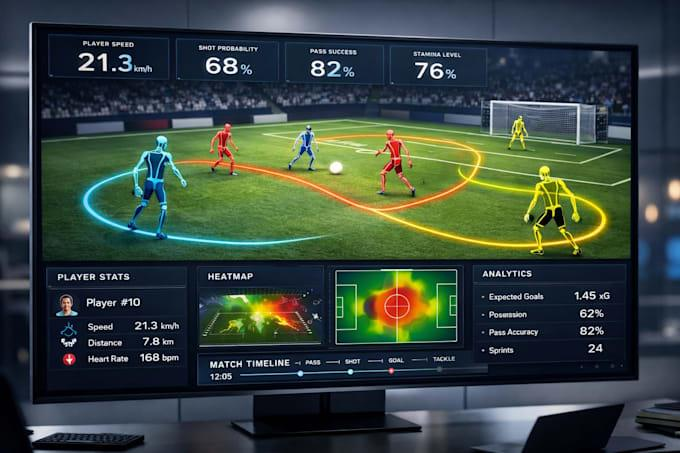
One of the easiest ways for coaches to understand tracking data is through a heat map.

A heat map can show where a player spent most of their time on the pitch.
It can help answer questions such as:
- Did the winger stay wide?
- Did the full-back move high enough?
- Did the midfielder drop too deep?
- Which zones did the player repeatedly occupy?
- Did the player’s positioning change during the match?
A heat map does not explain everything, but it gives coaches an immediate visual representation of movement.
Connecting Performance Data With Video
This is where AI tracking gets really interesting.
Imagine a coach sees that a player’s sprint distance dropped significantly in the second half.
The number alone does not explain why.
But if the tracking system is connected to video, the analyst can look at the exact moments where the change occurred.
Maybe the player was instructed to stay deeper.
Maybe the opposition changed its defensive shape.
Maybe the team stopped attacking through that side.
Maybe the player was struggling physically.
Data gives you the signal. Video provides the context.
What Can AI Performance Tracking Measure?
The answer depends on the platform, but modern systems can analyse several major areas.
Physical Performance
AI-assisted tracking can monitor:
- Distance
- Speed
- Sprinting
- Acceleration
- Deceleration
- High-speed running
- Workload
- Movement intensity
Tactical Positioning
Computer vision and tracking can help analyse:
- Player positioning
- Team shape
- Movement patterns
- Space occupation
- Defensive positioning
- Attacking runs
- Pressing behaviour
Training Workload
Across multiple training sessions, teams can compare:
- Daily workload
- Weekly workload
- Match workload
- High-intensity efforts
- Individual baselines
- Long-term trends
Electronic tracking systems are already used to inform training design and workload monitoring, although their accuracy depends on the hardware, software, sampling rate and methodology being used.
AI Performance Tracking vs Traditional Analysis
AI is not necessarily replacing traditional football analysis.
Instead, it can make parts of the process faster.
| Traditional Analysis | AI-Assisted Analysis |
|---|---|
| Manual data review | Automated processing |
| Large spreadsheets | Centralized dashboards |
| Slower comparisons | Rapid historical comparisons |
| Video reviewed separately | Data can connect to video |
| Human pattern recognition | AI-assisted pattern detection |
| Time-consuming reports | Automated reports |
The strongest approach is usually a combination.
AI processes the data. Coaches interpret the football.
The Biggest Benefits of AI Performance Tracking
Faster Analysis
A performance department can process thousands of data points without manually calculating every metric.
Personalized Training
Players do not all have identical physical profiles.
Tracking allows coaches to compare an individual player’s workload with their own historical data.
Better Workload Monitoring
Teams can see how physical demands change across training and matches.
Deeper Tactical Analysis
When movement data is connected with video, analysts can investigate both physical and tactical behaviour.
Long-Term Player Development
Historical data can create a performance record that shows how a player develops over months and seasons.
More Accessible Analytics
AI video tracking could also reduce the need for expensive dedicated hardware, potentially making advanced analysis more accessible to smaller teams.
The Limitations of AI Performance Tracking
AI sounds impressive, but it is not magic.
Data Accuracy
Tracking systems can produce different results depending on the technology and conditions.
A recent study found substantial differences between commercial computer-vision tracking providers when measuring player position, speed and total distance from broadcast footage.
Camera Quality
Video tracking works best when players are clearly visible.
Players can disappear behind other players, advertising boards or camera changes.
Tactical Context
A player running less does not necessarily mean they performed badly.
Their role may simply have changed.
Privacy
Athlete-performance information can be sensitive, particularly when systems collect large amounts of individual data.
Human Judgment Still Matters
AI can identify patterns.
It cannot completely replace the knowledge of a coach, analyst, sports scientist or medical professional.
The Future of AI Performance Tracking
The next stage is likely to be connected football data.
Instead of having separate platforms for GPS, video, scouting and workload management, clubs are increasingly looking for systems that combine different data sources.
Imagine a coach asking:
“Why has our right winger’s high-speed running decreased during the last five matches?”
An advanced system could potentially compare the player’s physical data, positioning, training workload and match video, then present the relevant trends.
That is a major shift.
The future is not simply about collecting more data.
It is about making the data easier to understand and use.
Who Uses AI Performance Tracking Systems?
Professional Football Clubs
Elite clubs can use tracking for performance analysis, tactical preparation, workload monitoring and recruitment.
Youth Academies
Academies can create long-term performance records for developing players.
Amateur Teams
More accessible computer-vision systems could allow smaller teams to analyse matches without expensive infrastructure.
Individual Players
Wearable GPS products can give individual players information about their own training.
Scouts and Recruitment Departments
Tracking data can help create physical and tactical profiles when evaluating potential players.
Technologies Behind AI Performance Tracking
| Technology | Main Purpose |
|---|---|
| GPS / GNSS | Player position and movement |
| Local Positioning Systems | High-precision tracking |
| Wearable Sensors | Physical movement data |
| Heart-Rate Sensors | Physiological information |
| Computer Vision | Video-based player tracking |
| Machine Learning | Pattern detection |
| AI Models | Automated interpretation |
| Heat Maps | Visual positioning |
| Video Analysis | Tactical context |
Modern research describes GPS/GNSS, local positioning and optical systems as major approaches used in electronic performance and tracking systems.
Quick Summary
- AI performance tracking systems combine sports data with artificial intelligence.
- GPS and GNSS devices can monitor player movement and workload.
- Computer vision can track players directly from football footage.
- Heat maps make positional data easier to understand.
- AI can compare current performances with historical data.
- Connecting tracking data with video provides more tactical context.
- Accuracy depends heavily on the quality of the hardware, software and footage.
- AI should support coaches rather than replace human judgment.
- The future is moving toward connected football data and automated analysis.
Frequently Asked Questions
What is an AI performance tracking system?
It is a system that uses technologies such as GPS, sensors, computer vision and artificial intelligence to collect and analyse athlete-performance data.
What can AI track in football?
Depending on the system, AI can track player position, speed, distance, sprinting, acceleration, deceleration, workload and tactical movement.
Can AI track football players without GPS?
Yes. Computer-vision systems can analyse match footage and track players without requiring them to wear GPS devices.
Can AI predict injuries?
AI can help identify workload patterns and unusual changes, but tracking data should not be treated as a guaranteed injury prediction. Medical and sports-science expertise remains important.
Are AI tracking systems only for professional clubs?
No. The technology is increasingly being developed for academies, amateur clubs and other organisations that previously could not afford advanced tracking infrastructure.
Why are football heat maps useful?
They provide a quick visual representation of where a player operated on the pitch and can help coaches analyse positioning and movement patterns.
Final Thoughts
AI performance tracking is changing how football teams understand their players.
The biggest breakthrough is not simply being able to calculate how many kilometres someone ran.
It is the ability to connect movement, speed, workload, positioning and video and turn those separate pieces of information into a clearer picture of performance.
The coach still matters.
The analyst still matters.
The sports scientist still matters.
But with AI handling more of the heavy data-processing work, they can spend more time asking the questions that actually matter.
The future of football performance analysis is not AI versus humans.