


Modern football is often associated with possession, controlled build-up and carefully organised pressing structures. However, Chelsea’s tactical approach under Xabi Alonso represents a different way of thinking about the game.
Rather than focusing on dominating possession or consistently building attacks from the back, Chelsea appear more interested in moving the ball forward as quickly as possible.
Their approach is built around aggressive attacking transitions, direct passes and positional rotations designed to exploit spaces behind the opposition’s defensive line.
This has made Chelsea a dangerous attacking team, but it also comes with a significant defensive risk.
By allowing opponents to have more possession and committing players towards the side of the ball, Chelsea can leave large spaces elsewhere on the pitch.
So, is Alonso’s tactical approach a clever way to maximise his attacking players, or is it a system that could eventually expose Chelsea defensively?
1. A Completely Different Chelsea Identity
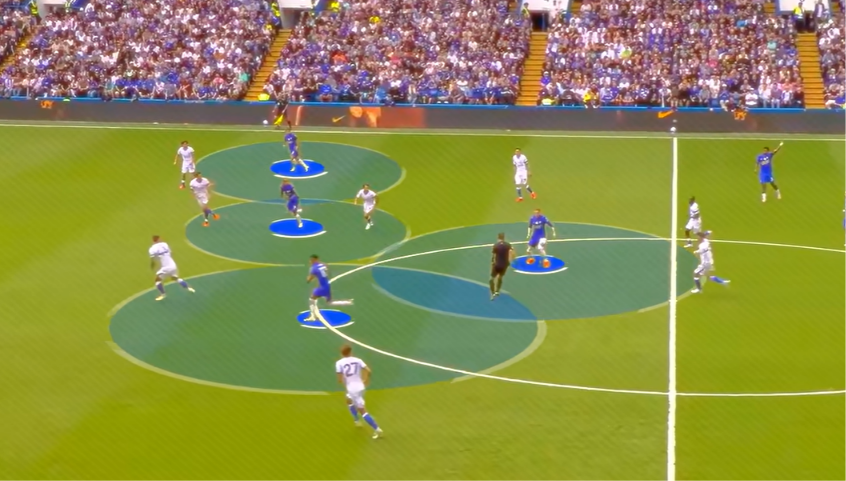
Previous Chelsea teams often prioritised controlling matches through possession and structured build-up play.
Under Alonso, the emphasis appears to have shifted.
The main objective is to move the ball into advanced areas as quickly as possible, even if that means bypassing the traditional build-up phase.
Instead of patiently progressing through the defensive and midfield lines, Chelsea frequently use direct passes towards João Pedro.
Cole Palmer and Morgan Rogers then position themselves to collect second balls, combine around the forward and attack the spaces created by the opposition’s defensive movements.
This approach creates a more direct and unpredictable attacking style.
However, it also means Chelsea sometimes surrender control of possession and allow opponents to establish their own attacking patterns.
2. Chelsea’s High Press Is More Selective Than It Appears
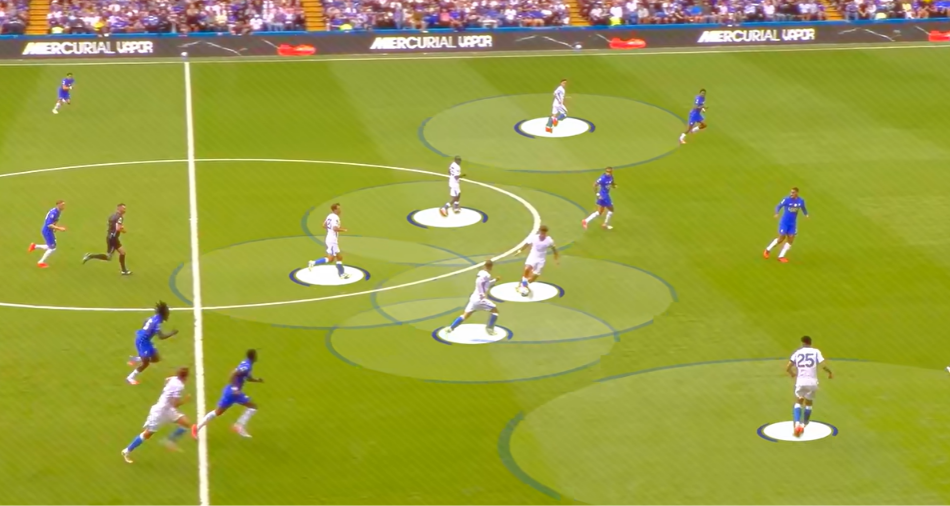
One interesting feature of Chelsea’s defensive approach is that they do not necessarily press continuously throughout the match.
Their pressing numbers are described in the source analysis as being lower than the previous season.
However, this does not mean they avoid pressing altogether.
Instead, Chelsea use specific pressing triggers to force opponents into uncomfortable situations.
How the Front Three Create Pressing Traps
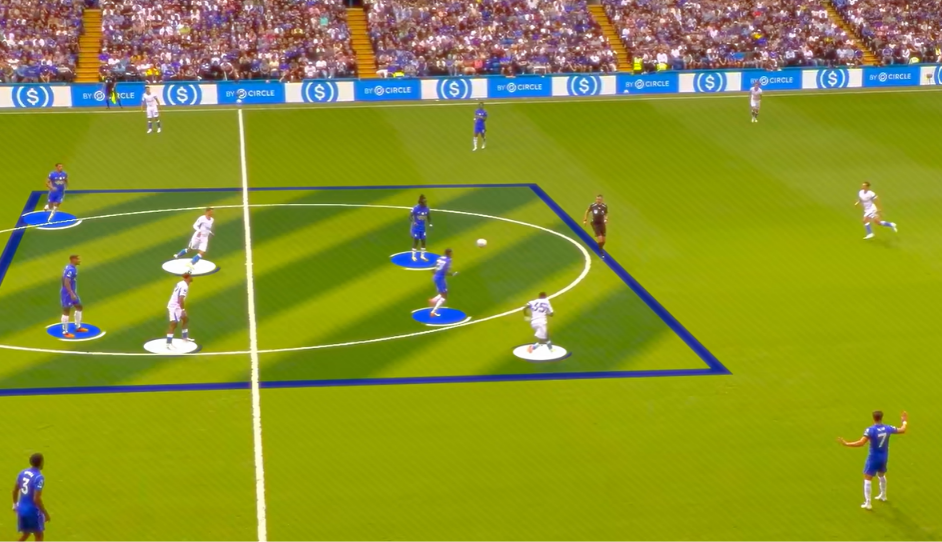
Chelsea often begin their high press with a narrow front three.
João Pedro is responsible for closing the goalkeeper, while Morgan Rogers and Cole Palmer move towards the opposition’s centre-backs.
This positioning can leave a central player apparently free to receive possession.
However, that space is not necessarily available in practice.
João Pedro’s positioning blocks the direct passing route into the centre. If the ball moves towards one of the centre-backs, one of the attacking midfielders can move inside to close the passing option.
This creates a situation in which the opponent has very few comfortable choices.
The centre-back may eventually be forced to play a long ball, allowing Chelsea to compete for possession further up the pitch.
How the Press Created an Opportunity Against Fulham
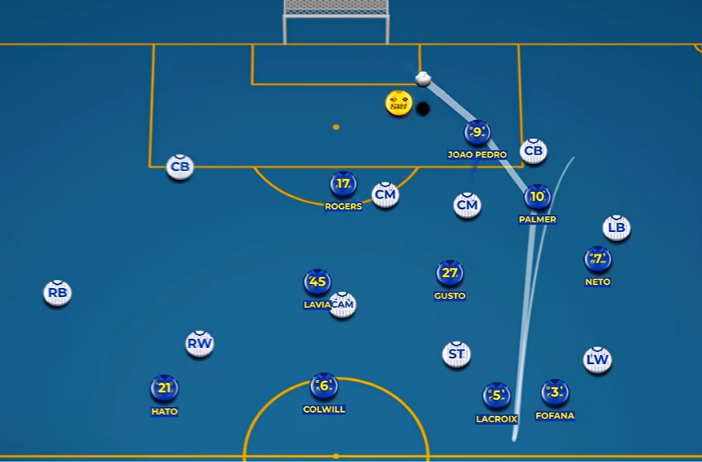
The source analysis highlights Chelsea’s early goal against Fulham as an example of this pressing structure.
Chelsea forced the opposition towards the wide area and removed the available short passing options.
With João Pedro blocking the route back towards the goalkeeper, Fulham were left with a long pass.
Lacroix intercepted the ball, putting Palmer and Pedro in an excellent position to attack the defensive line.
The important detail is that Chelsea’s pressing was designed to create a predictable passing situation rather than simply chase the ball.
3. The Mid-Block Trap: How Chelsea Invite Opponents Forward
When opponents manage to progress possession, Chelsea move into a more organised mid-block.
Depending on the opposition’s attacking structure, this can take the form of a 5-2-3 or a 5-3-2.
The difference depends largely on how many players the opponent keeps in its defensive line.
Against Fulham, Chelsea maintained a front three, with Palmer and Rogers operating on a similar pressing line.
Against Brighton, the structure changed because Brighton generally used fewer players in their defensive line.
Rogers could therefore move into midfield to create a line of three and help balance the numerical situation.
This flexibility allows Chelsea to adjust their defensive shape according to the opponent.
Inviting Passes Into Dangerous Areas
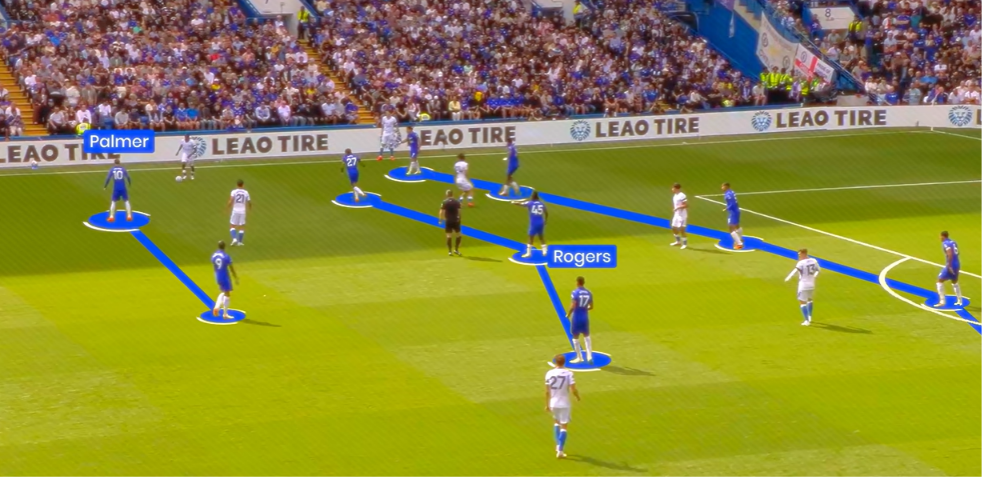
Chelsea’s mid-block is not necessarily designed to recover possession immediately.
Instead, the objective is to encourage opponents to pass into certain midfield areas.
Once the ball enters those zones, Chelsea attempt to surround the receiving player and create a numerical advantage around the ball.
The midfielders can step forward, while the attacking players position themselves to attack immediately after possession is recovered.
This means Chelsea are deliberately inviting passes that appear available but are difficult to complete safely.
The approach can turn an opponent’s attempt to progress possession into an opportunity for a quick counterattack.
4. The Importance of Defensive Line Rotations
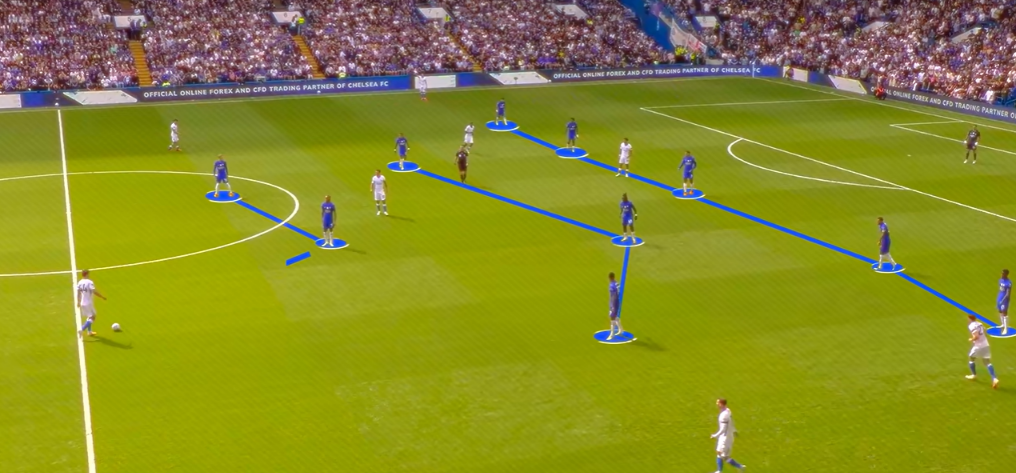
Chelsea’s defensive line is not always fixed in its positioning.
Although the team begins with a back five, defenders are encouraged to follow opponents when they move towards the ball.
For example, when an attacking player receives possession with his back towards goal, a Chelsea defender may step forward to prevent him from turning.
Once that player is no longer involved in the attacking move, the defender can return to the defensive line and help protect the space behind.
This requires excellent communication and coordination.
Creating a Numerical Advantage Around the Ball
The objective is to create an extra defensive player on the side where possession is located.
Wing-backs may move forward to pressure opposing full-backs, while centre-backs adjust their positions to cover the spaces created.
At the same time, the two holding midfielders may need to change their positions to support the defensive line.
These constant adjustments can make it extremely difficult for opponents to progress through short passing combinations.
However, they also introduce a major risk: every movement creates the possibility of leaving another area unprotected.
5. The Biggest Risk: Defensive Spaces Behind the Midfield
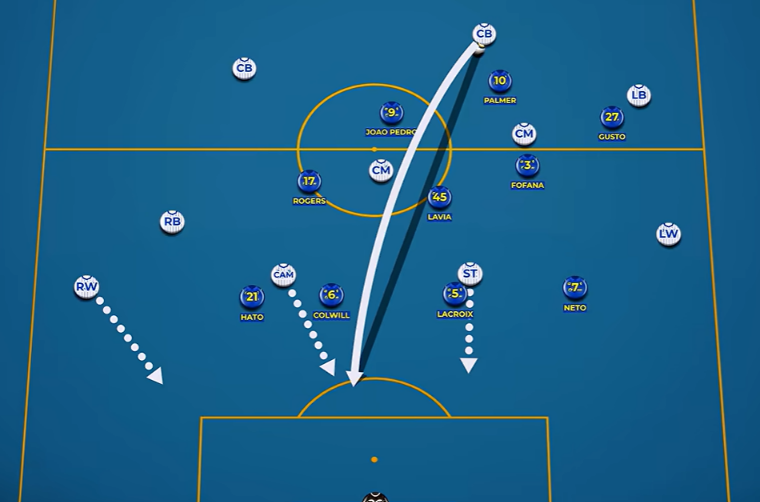
Chelsea’s system can become vulnerable when the defensive rotations are not perfectly coordinated.
Because the team often relies on only two central midfielders, protecting every area in front of the defensive line can be difficult.
When both midfielders move towards one side to create a numerical advantage, the opposite side may become available.
This is particularly dangerous against teams that can switch the ball quickly.
An opponent can attract Chelsea’s defensive structure towards one flank before moving possession to the opposite side.
The defenders then have to reorganise while the attacking players already have time to prepare their next action.
How Brighton Exploited the Space
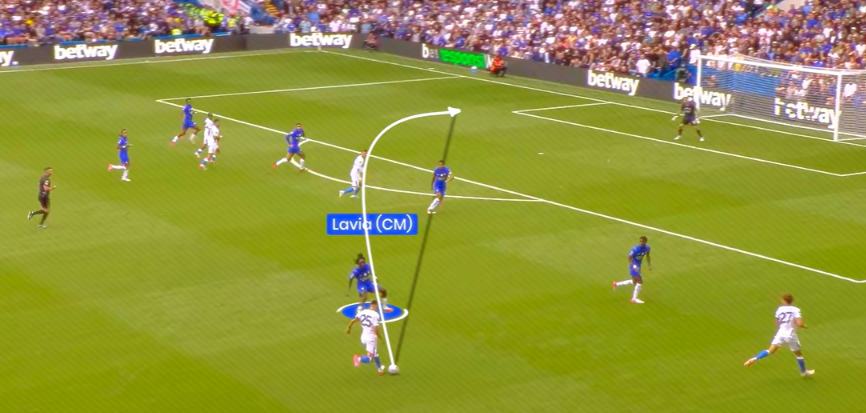
The source analysis highlights a situation against Brighton involving Lavia and Malo Gusto.
Both players had moved towards the right side of the pitch, while Brighton maintained attacking width on the opposite flank.
Hato could not immediately move forward because of the threat of a pass down the line.
By the time Lavia recovered his position, Brighton had enough time to prepare a cross towards the far post.
The delivery found attacking players in a dangerous position and forced a save from Martínez.
This demonstrates the main weakness of Chelsea’s approach.
Even when the defensive structure works well on the ball side, one accurate switch of play can expose the space left on the opposite flank.
6. Why Chelsea Are Not Always Building From the Back
Another major feature of Alonso’s approach is the reduced emphasis on short build-up play.
The source analysis highlights a match against Brighton in which Chelsea did not play out from the back during the goalkeeper’s build-up phase.
Instead, the most common passing combination involved a direct ball from Martínez towards João Pedro.
This approach has several advantages.
First, it allows Chelsea to bypass the opponent’s initial pressing structure.
Second, it creates opportunities for their attacking players to compete for second balls.
Third, it gives quick players such as Pedro Neto the opportunity to attack spaces behind the defensive line.
The Role of João Pedro
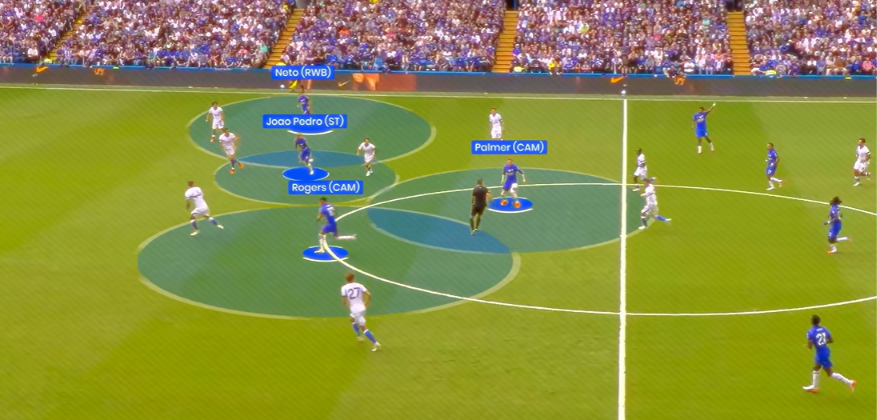
João Pedro is particularly important because he provides a target for direct passes.
If he wins the initial aerial or physical duel, Palmer and Rogers can move towards the loose ball and continue the attack.
If the opponent wins the first contact, Chelsea can still use their attacking positioning to pressure the second ball.
This creates a direct route into dangerous areas without requiring long sequences of passing from the defensive line.
The approach is not necessarily about abandoning possession completely.
It is about choosing when direct play offers a better opportunity than building slowly.
7. Chelsea’s 3-4-2-1 Formation and Attacking Freedom
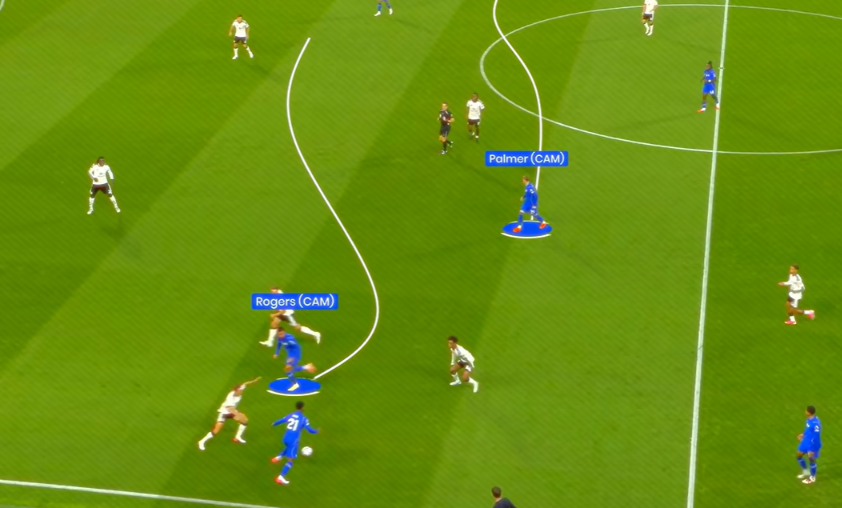
When Chelsea establish possession and begin a more structured attack, their basic formation is a 3-4-2-1.
This system provides several attacking possibilities.
The wing-backs can push forward to stretch the opposition, while the two attacking midfielders operate in the half-spaces behind the striker.
The midfield also provides central support, allowing Chelsea to move players forward without completely losing their structure.
However, Alonso appears to give his attacking players considerable positional freedom.
Cole Palmer and Morgan Rogers frequently move towards the same side of the pitch instead of remaining in fixed positions.
This creates local numerical advantages and makes it difficult for opponents to know which player they should follow.
How Palmer and Rogers Combine
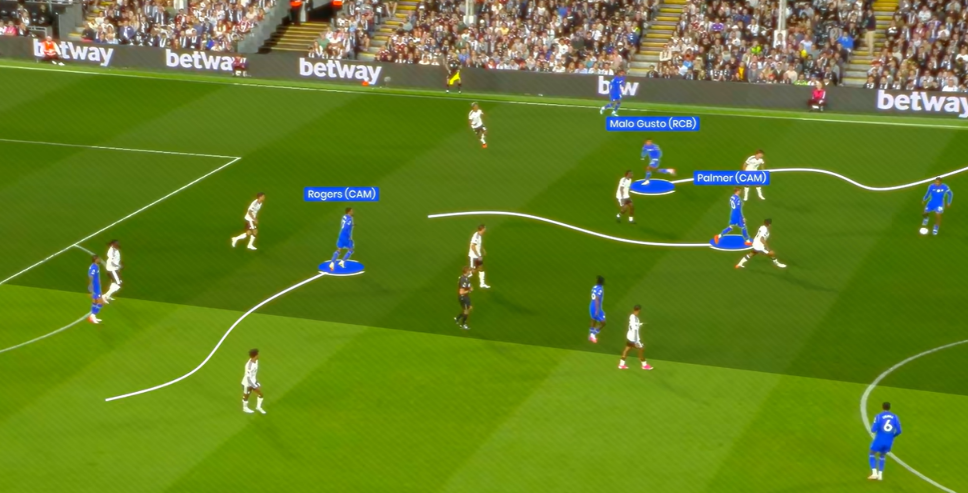
Palmer often drops towards the ball, creating space for Rogers to move into more central positions.
At the same time, one of the midfielders can attack the half-space.
This means Chelsea can bring five or six players into the same area of the pitch.
Although this might appear crowded, the purpose is to overwhelm the opponent in a specific zone and create a numerical advantage.
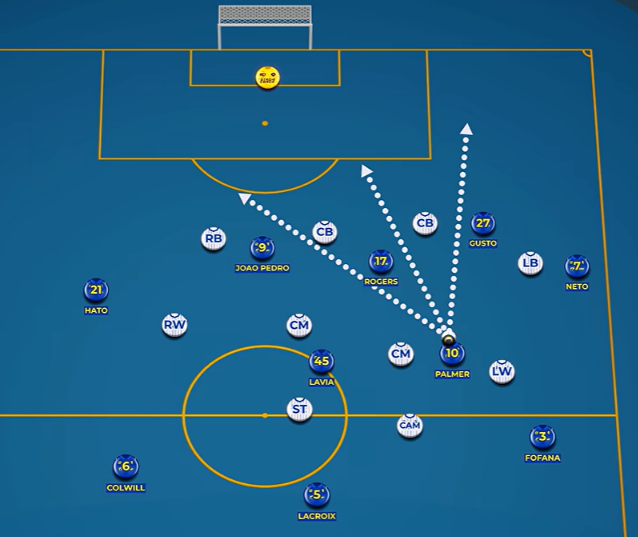
Against Fulham, the source analysis describes a sequence in which Palmer and Rogers moved towards the right flank.
Palmer dropped deeper, Malo Gusto attacked forward and Rogers occupied the space between the lines.
Chelsea then switched the ball towards the opposite flank.
Because Fulham had shifted across to defend the overload on the right, space became available on the left.
Palmer was then able to receive possession and play Rogers into space.
This is an example of how positional freedom can create opportunities through coordinated movement rather than fixed attacking positions.
8. Why Chelsea’s Attacks Are So Dangerous
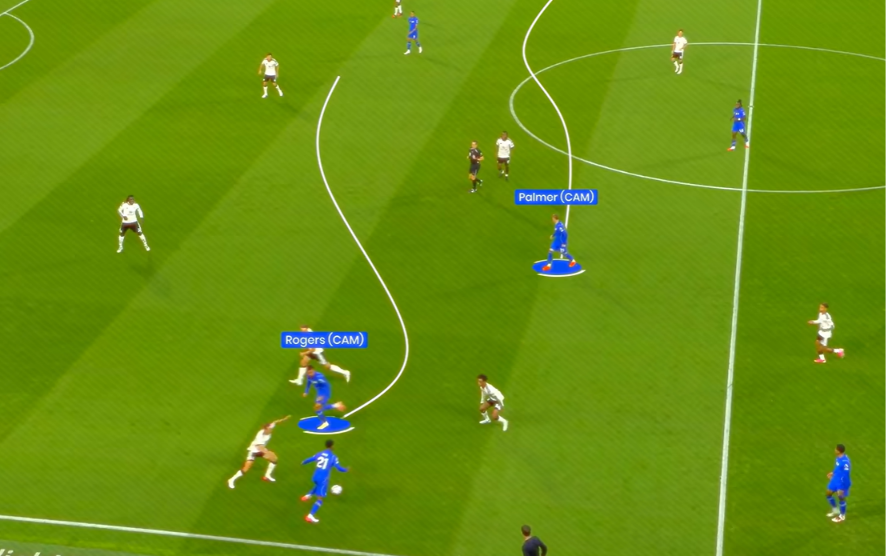
Chelsea’s attacking structure is designed to create opportunities from deeper positions.
Instead of relying exclusively on possession around the penalty area, they use direct passes, through balls and forward runs to attack spaces behind the opposition.
Their main attacking patterns include:
- Direct passes towards João Pedro.
- Second-ball combinations involving Palmer and Rogers.
- Runs into the half-spaces.
- Quick switches towards the opposite flank.
- Cutbacks across the penalty area.
- Forward movements from the wing-backs.
This combination makes Chelsea difficult to defend because their attacks can develop through several different routes.
Opponents must decide whether to press the ball, protect the central areas or defend the space behind their defensive line.
That uncertainty is a major part of Chelsea’s attacking threat.
9. Is Alonso’s System Worth the Risk?
Chelsea’s approach offers an interesting alternative to possession-dominated football.
By prioritising direct progression and attacking transitions, Alonso can make better use of players who are particularly dangerous in open spaces.
However, the system depends heavily on coordination.
The defensive line must know when to step forward, the midfielders must protect the central spaces, and the wing-backs must understand when to attack the opposition’s full-backs.
If one movement is poorly timed, large spaces can appear.
The system also places significant responsibility on the attacking players.
When Palmer, Rogers and João Pedro are performing well, their creativity and movement can compensate for some defensive weaknesses.
But if their attacking influence decreases, Chelsea may find it much harder to outscore opponents while conceding dangerous opportunities.
10. What Other Teams Can Learn From Chelsea
Chelsea’s tactical approach highlights several important ideas for modern football.
1. Pressing does not always mean constant pressure
Teams can use selective pressing triggers to force opponents into predictable situations.
2. Direct football can be tactically sophisticated
Long passes and second-ball situations can be part of a carefully organised attacking strategy.
3. Positional freedom can create numerical advantages
Allowing attacking players to rotate towards the same side can help overwhelm opponents in specific areas.
4. Defensive flexibility requires excellent communication
Players must understand when to leave their positions and when to recover into the defensive structure.
5. Attacking risk comes with defensive consequences
A system that commits players towards the ball can create dangerous opportunities on the opposite side.
Frequently Asked Questions
What formation does Chelsea use under Xabi Alonso?
According to the tactical analysis, Chelsea’s basic attacking structure is a 3-4-2-1, while their defensive shape can change between a 5-2-3 and a 5-3-2.
Why does Chelsea play long balls instead of building from the back?
Direct passes can bypass the opposition’s initial press and allow Chelsea’s attacking players to compete for second balls and attack the defensive line quickly.
How does Chelsea’s high press work?
The front three begin in a narrow structure, blocking central passing options and encouraging opponents to play towards the wide areas or attempt longer passes.
What is Chelsea’s biggest defensive weakness?
The main risk is the space left in front of the defensive line and on the opposite flank when midfielders and defenders move towards the side of the ball.
Why are Cole Palmer and Morgan Rogers important?
Their positional rotations help Chelsea create numerical advantages, connect attacks and exploit spaces between the opposition’s defensive and midfield lines.
Final Thoughts
Xabi Alonso’s Chelsea represent a different approach to controlling football matches.
Rather than relying primarily on possession, they focus on direct progression, selective pressing and attacking transitions.
Their 3-4-2-1 structure provides flexibility in possession, while their defensive system attempts to create traps that encourage opponents into difficult situations.
The rewards can be significant, but so are the risks.
When Chelsea coordinate their movements effectively, they can overwhelm opponents and create dangerous attacking opportunities. However, when their defensive rotations fail, the spaces left behind can become extremely difficult to protect.
The biggest question is whether Alonso can maintain the balance between attacking freedom and defensive security throughout the season.