
France’s Biggest Strength Isn’t Just Talent
France have never lacked world-class attackers, but the 2026 World Cup squad may be their deepest yet.
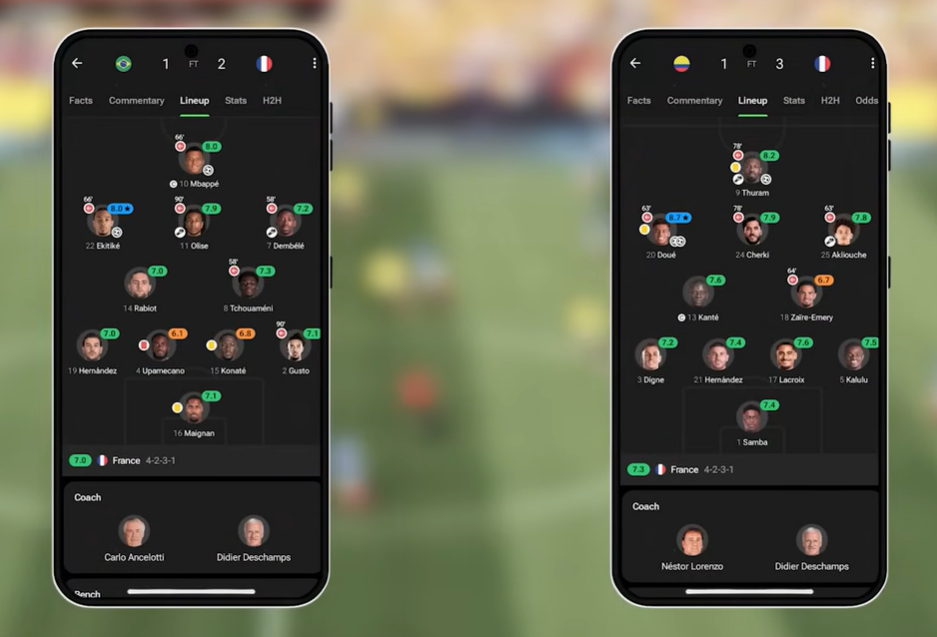
With Kylian Mbappé, Ousmane Dembélé, Michael Olise, Hugo Ekitiké, Marcus Thuram, Rayan Cherki, Désiré Doué and Maghnes Akliouche all competing for places, Didier Deschamps has more attacking options than almost any manager in international football.
The challenge, however, is not finding talented players. It is building a system that allows them to play together without sacrificing balance.
From France’s recent friendlies, it is clear Deschamps is less focused on finding his best eleven than creating a tactical structure where different combinations of players can thrive while maintaining the same identity.
A Stable Defensive Base Gives France Freedom
Everything starts with France’s shape.
Regardless of the personnel, Deschamps has consistently used a back four supported by two holding midfielders. This defensive platform allows the attacking players to take far greater risks higher up the pitch.
Unlike many international teams that rely on rigid positional play, France give their forwards significant freedom to move across the front line. The stability behind them ensures those rotations do not leave the team exposed when possession is lost.
Instead of changing their overall formation, France simply change the profiles of the players occupying each role, making them extremely flexible without becoming unpredictable for their own teammates.
Full-Backs Create the Width So the Attackers Can Roam
One of the most interesting aspects of France’s attack is where the width comes from.
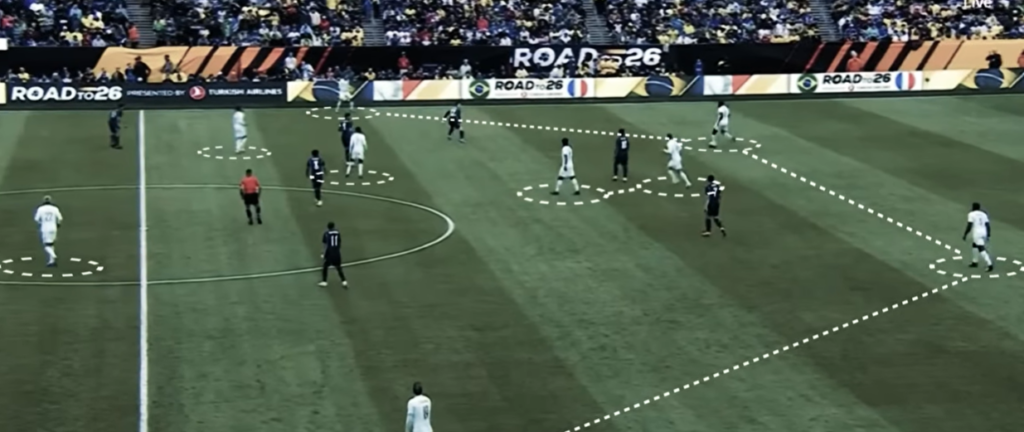
Rather than asking Dembélé or Olise to stay wide throughout the game, Deschamps pushes both full-backs high up the pitch.
This immediately opens space for the four attackers to drift into central areas where they can combine more effectively.
Instead of occupying fixed positions, Dembélé frequently drops deep to receive possession before carrying the ball inside. Olise does the same, often moving into the right half-space where he can dictate play with his passing.
The result is an attacking structure filled with constant movement rather than static positioning.
Defenders rarely know who they should mark because the front four continuously exchange positions during every attack.
Mbappé and Ekitiké Offer Perfect Balance
Although every attacker enjoys positional freedom, one partnership appears particularly important.
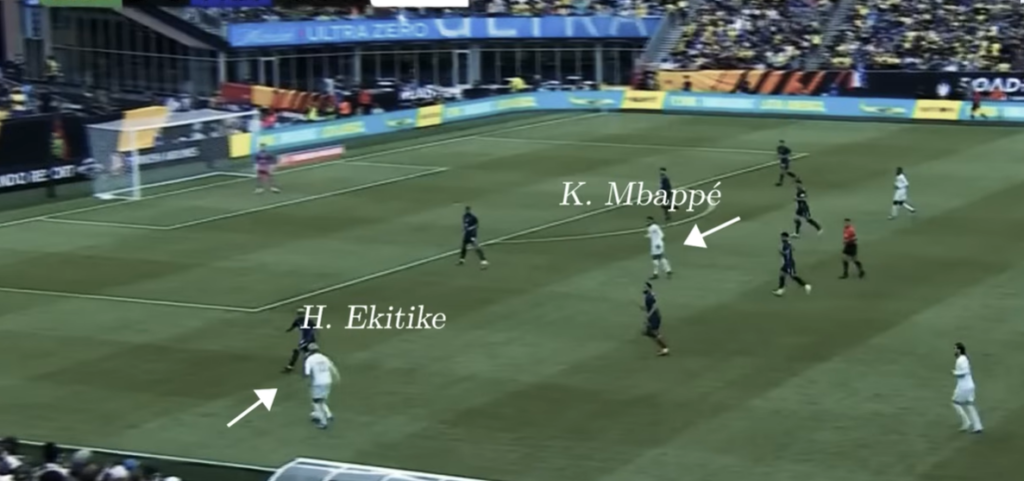
Mbappé naturally drifts across the left side and central areas, looking to receive the ball facing goal or attack space behind the defence.
Ekitiké performs a different role.
Rather than constantly leaving the penalty area, he often remains as the central reference point. He links play, occupies centre-backs and creates space for Mbappé’s movements.
This balance prevents France from becoming too fluid.
Without a striker willing to stay central, Mbappé’s movement could leave the box empty. Ekitiké solves that problem while also possessing the technical ability to move wide whenever Mbappé attacks central spaces.
Instead of competing for the same areas, the two forwards naturally complement one another.
France’s Second Team Plays a Completely Different Style
The second friendly revealed another side of France.
With Marcus Thuram leading the line alongside Rayan Cherki, Désiré Doué and Maghnes Akliouche, France relied less on direct running and more on combination football.
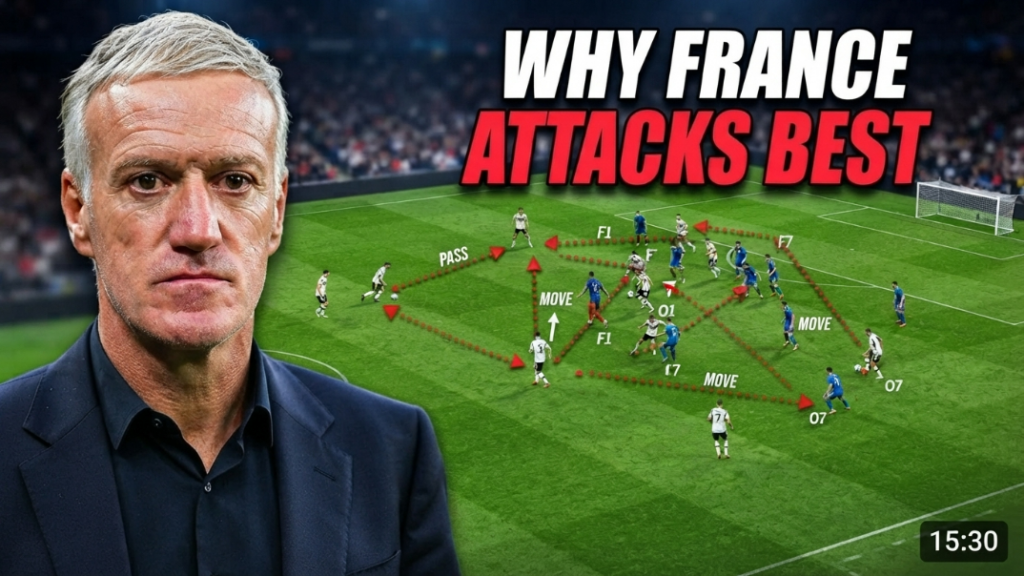
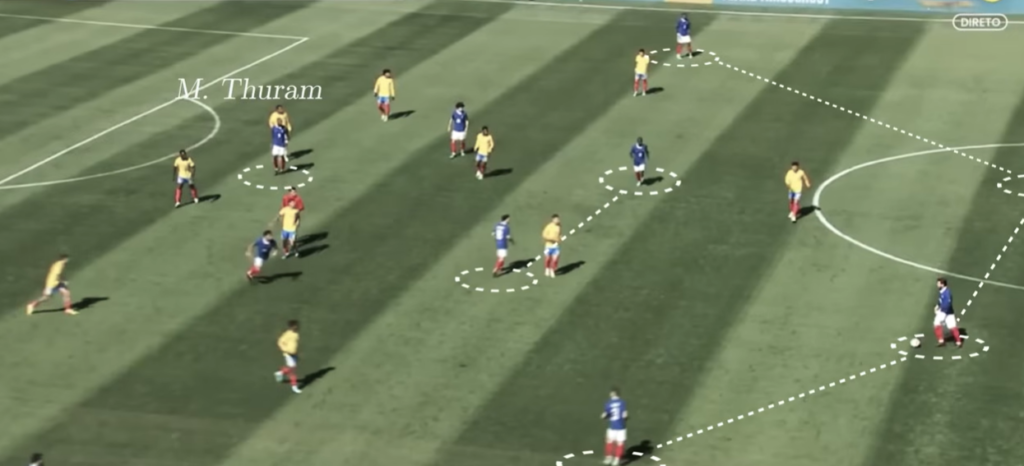
Instead of waiting for Mbappé to attack space, the team progressed through short passing sequences, quick one-twos and intelligent third-man runs.
Players constantly passed before immediately moving into new spaces, creating passing triangles all over the pitch.
These movements allowed France to bypass pressure without relying on individual dribbling.
Rather than forcing difficult passes, they simply created better passing angles through intelligent movement.
It was a far more collective approach that highlighted the technical quality available throughout the squad.
Midfield Movement Changes Everything
The biggest difference between the two tactical versions was not actually the forwards.
It was the midfield.
When players like N’Golo Kanté and Warren Zaïre-Emery became more involved, France looked far more dynamic.
Instead of simply recycling possession, both midfielders regularly supported attacks with forward runs, quick combinations and intelligent positioning between the lines.
This created additional passing options for the forwards while making it much harder for opponents to defend.
Every time Cherki dropped deep or Thuram occupied defenders, a midfielder immediately attacked the newly created space.
Those coordinated movements made France’s possession much more unpredictable than in previous tournaments.
Tactical Flexibility Could Be France’s Greatest Weapon
Perhaps the most impressive aspect of this France side is their adaptability.
If Deschamps wants direct transitions, he can build around Mbappé’s pace.
If he wants patient possession, he has creative players capable of controlling games through combinations.
The defensive structure remains almost identical, but the attacking behaviour changes depending on the players selected.
That makes France incredibly difficult to prepare for because opponents cannot focus on stopping just one style of football.
Every lineup offers different strengths while maintaining the same tactical foundation.
Key Tactical Strengths
| Tactical Area | France’s Strength |
|---|---|
| Defensive Base | Back four with two holding midfielders |
| Width | High and aggressive full-backs |
| Positional Play | Free movement between the front four |
| Chance Creation | Combination play and third-man runs |
| Midfield | Dynamic support through forward movements |
| Flexibility | Two different attacking systems without changing the overall structure |
Final Verdict
France’s attack is about much more than individual brilliance.
Deschamps has built a tactical framework that gives elite players the freedom to express themselves while keeping the team balanced defensively. Whether France attack through Mbappé’s explosive movement, Ekitiké’s link-up play or the fluid combinations of Cherki and Thuram, the principles remain the same: intelligent rotations, aggressive support from midfield and constant movement around the ball.
If these tactical ideas continue to develop throughout the tournament, France will not only possess one of the deepest squads at the 2026 FIFA World Cup, but also one of its most complete and unpredictable attacking systems.