
Arsenal’s performance against Manchester City in the Community Shield final offered an interesting look at the tactical ideas both teams could bring into the new season.
While Manchester City attempted to control possession through their familiar positional structure, Arsenal showed how an organised defensive system can disrupt even the most sophisticated build-up.
Mikel Arteta’s side combined aggressive man-marking during City’s initial build-up with a compact 4-4-2 mid-block when the opposition progressed into midfield.
The result was a difficult afternoon for Manchester City, who enjoyed possession but struggled to turn it into dangerous attacking opportunities.
Arsenal were also impressive going forward, using midfield rotations, overlapping runs and intelligent movement between the lines to exploit the spaces left by City’s defensive structure.
Here is a closer look at the tactical decisions that shaped the match.
1. Arsenal’s Aggressive High Press
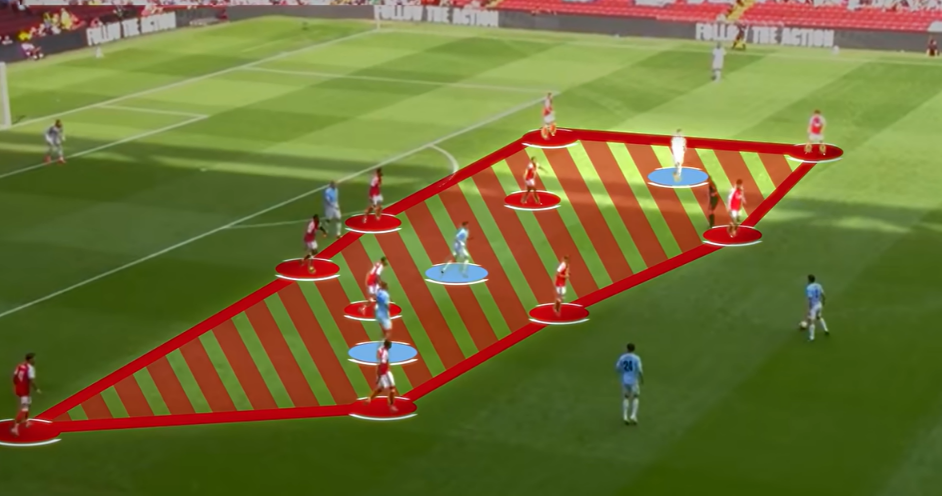
One of the most important features of Arsenal’s performance was their approach to pressing Manchester City from the back.
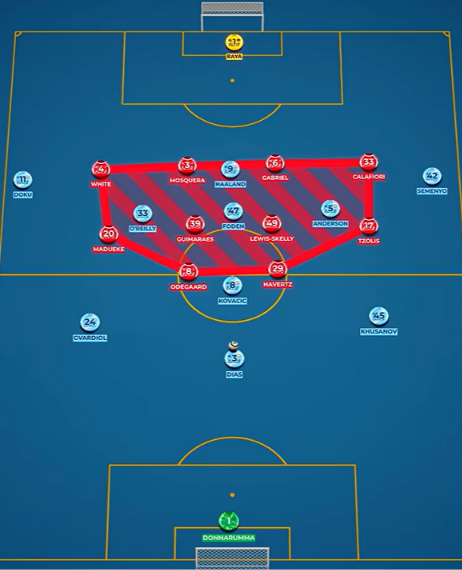
When City attempted to build possession through goalkeeper Donnarumma, their players moved into a flexible structure based on their usual 4-2-3-1 formation.
The centre-backs moved towards wider positions, while O’Reilly and Khusanov pushed forward. Anderson moved into the right inside channel to support Phil Foden, leaving Kovacic as the central holding midfielder.
Arsenal responded with an aggressive man-marking system.
Ødegaard positioned himself close to Kovacic, while Madueke and Havertz moved towards the two centre-backs. Tzolis and Guimarães covered the full-backs, with one of Arsenal’s centre-backs ready to step forward and track Foden.
This approach made it difficult for City to find free players during their initial build-up.
Why Arsenal’s Press Was Effective
Arsenal did not simply wait for Manchester City to make mistakes.
They actively prevented City from establishing their preferred passing structure.
Havertz rushed towards Donnarumma, while the other Arsenal players stayed close to their direct opponents.
This reduced the time available to receive the ball and forced City into difficult decisions.
Although Arsenal experienced some early confusion when dealing with City’s rotations, they gradually improved their coordination and made it increasingly difficult for their opponents to progress.
2. The 4-4-2 Mid-Block That Stopped City’s Midfield
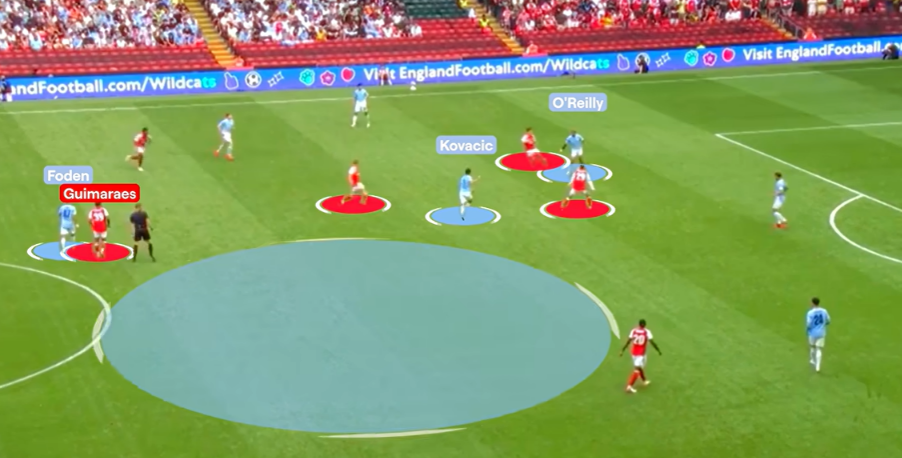
Manchester City were still able to move the ball into midfield, but this did not mean they were controlling the dangerous areas of the pitch.
As City advanced, their attacking structure developed into a 3-1-3-3 formation.
O’Reilly moved into the left half-space, Foden operated behind Haaland, and Anderson occupied the right inside channel.
Meanwhile, Semenyo and Doku stretched the pitch from the wide positions.
This structure was designed to create a numerical advantage in central midfield.
On paper, City’s three central players could overload an opposition midfield containing only two players.
However, Arsenal had a clear solution.
Instead of continuing to follow every opponent individually, they moved into a more organised zonal 4-4-2 structure.
How Arsenal Neutralised the Numerical Advantage
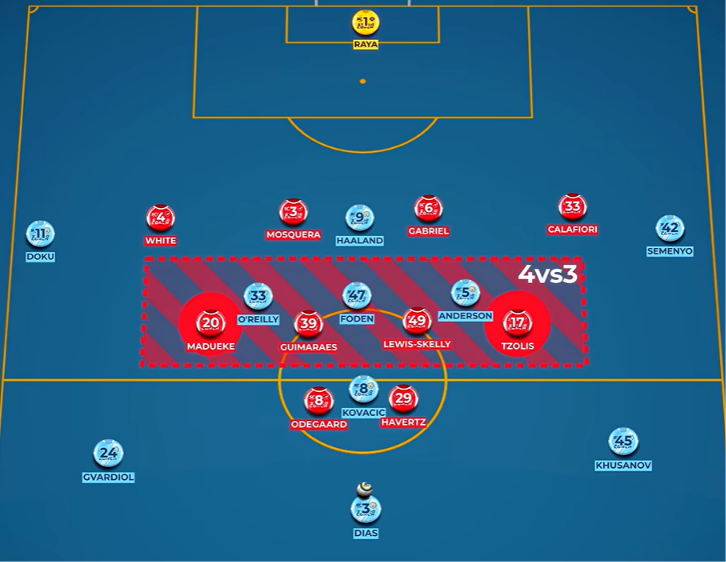
Ødegaard and Havertz stayed close to the central areas instead of immediately chasing every player receiving possession.
This protected the space around Kovacic and made it difficult for City to progress directly through the middle.
At the same time, Madueke and Tzolis moved closer to Anderson and O’Reilly.
This allowed Arsenal to create additional defensive support around the central areas.
When City attempted to move the ball forward, Arsenal shifted across the pitch together.
Madueke could step forward to pressure the ball, Guimarães could move towards the wide area, and Tzolis could move inside to cover Anderson.
The objective was not always to win possession immediately.
Instead, Arsenal wanted to remove the dangerous forward passing options and force City to circulate the ball without making progress.
3. Arsenal Used Controlled Pressing Rather Than Constant Pressure
One particularly interesting detail was the way Arsenal approached players who had time on the ball.
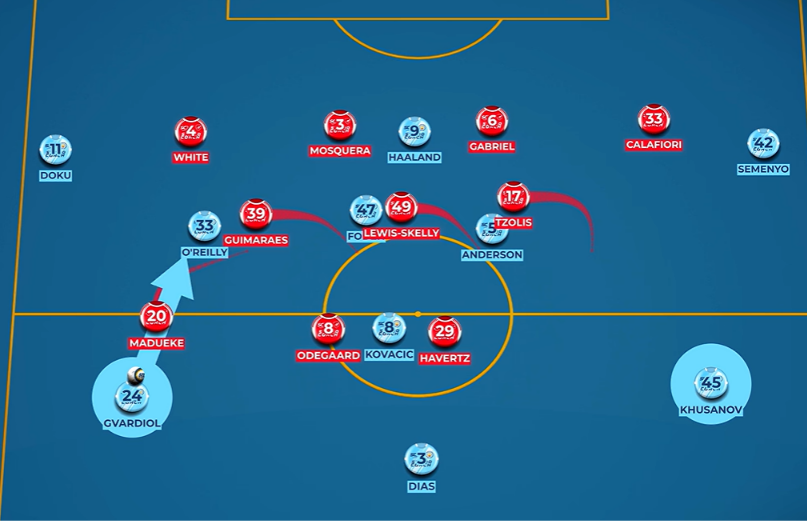
When Khusanov received possession, Tzolis did not simply rush towards him.
Instead, he curved his movement to restrict the passing option towards Anderson.
This allowed Arsenal to protect the central channel without committing too many players forward.
Khusanov technically had time to control the ball, but the available passing options were limited.
The other Arsenal players were already positioned to cover City’s attacking options.
Whenever City attempted to play backwards, Arsenal increased the intensity of their pressure and moved forward together.
This forced City towards their goalkeeper or encouraged rushed passes that could be intercepted.
The result was a defensive structure that allowed Manchester City to keep possession in certain areas but prevented them from creating dangerous situations.
4. Why Manchester City’s Wide Players Struggled
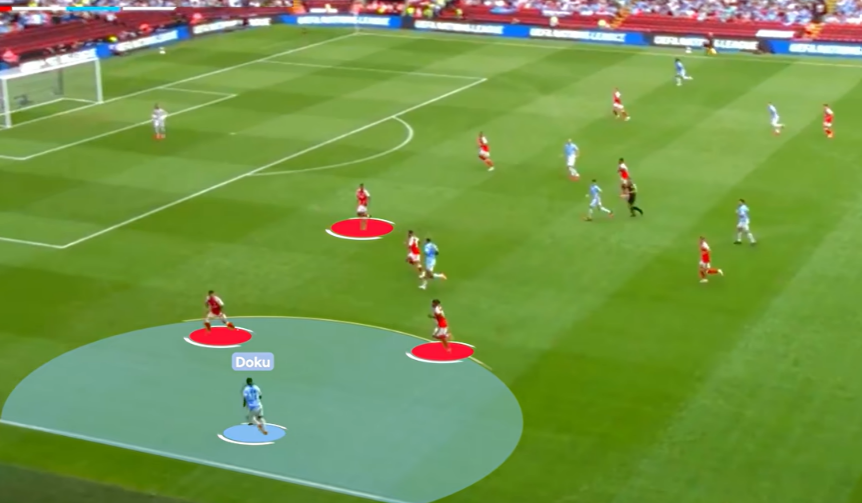
Another problem for Manchester City was their inability to isolate their wingers in favourable one-on-one situations.
When the ball reached Doku or Semenyo, Arsenal’s wide players were ready to provide defensive support.
Their full-backs also had the option of stepping forward when necessary.
This meant City’s wingers often received the ball without enough support nearby.
Instead of attacking a defender in an isolated situation, they frequently found themselves surrounded by several Arsenal players.
As a result, City were often forced to pass backwards rather than continue their attacks.
This is an important tactical principle: creating wide positions is not enough on its own. Teams also need supporting movements that allow their wingers to attack defenders with space and options around them.
5. When Manchester City’s 3-1-3-3 Became Dangerous
Despite Arsenal’s defensive success, Manchester City still created a few situations where their attacking structure worked effectively.
The main danger appeared when City moved the ball quickly from one side of the pitch to the other.
In one sequence, Foden managed to escape Guimarães and receive the ball with enough time to turn.
Tzolis had moved forward to anticipate a possible pass towards Khusanov, leaving Anderson with more space in the central area.
Foden was therefore able to progress forward, while Anderson received the ball and delivered a cross into the penalty area.
The delivery narrowly failed to find Haaland.
A similar situation occurred when City progressed through the inside channels.
Because Arsenal’s players had been drawn towards other opponents, Foden found space near the edge of the penalty area and forced a save from Raya.
These moments showed that City’s 3-1-3-3 structure could still be dangerous when the ball moved quickly enough to disrupt Arsenal’s defensive positioning.
6. Arsenal’s Midfield Rotations Created Problems for City
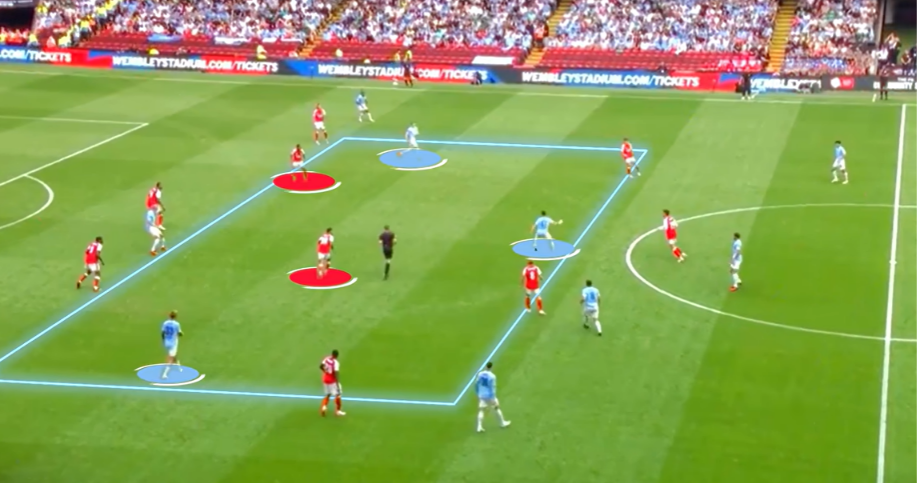
Arsenal were not only impressive defensively. Their attacking movements also created significant problems for Manchester City.
When Arsenal had possession, their formation changed from the initial 4-3-3 structure.
Lewis-Skelly frequently moved between the centre-backs, while Guimarães operated as the single pivot.
Ødegaard moved into the right inside channel, while Calafiori occupied similar spaces on the left.
These movements created a flexible midfield structure that was difficult for City to track.
How Arsenal Created Numerical Advantages
The most important aspect was the way Arsenal’s midfielders rotated together.
Rather than remaining in fixed positions, they frequently moved towards the same side of the pitch.
This created uncertainty for City’s midfielders.
For example, when Doku moved forward to close down Ben White, space could appear for Ødegaard in the central area.
Kovacic was not always able to step forward because Guimarães was occupying another important position.
This allowed Ødegaard to receive the ball, turn and progress towards the attacking third.
Arsenal could then use Ben White’s overlapping movement to create additional options on the right flank.
7. Calafiori’s Role as a Free-Roaming Full-Back
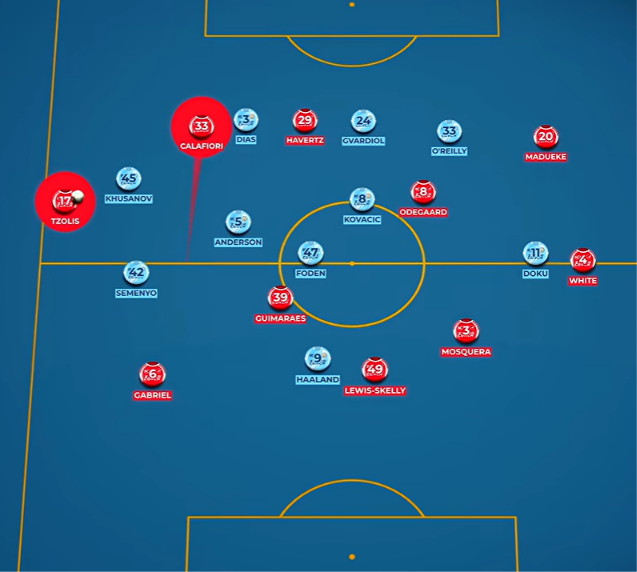
One of the most interesting features of Arsenal’s attacking structure was the role of Calafiori.
Rather than remaining in a traditional full-back position, he frequently moved into the left half-space.
This allowed him to support midfield, create passing options and move forward without depending entirely on overlapping runs.
His movements also created additional problems for Manchester City’s defensive organisation.
When Calafiori moved inside, Tzolis could remain wider and stretch the opposition’s defensive line.
This created a useful partnership between the two players.
How Calafiori and Tzolis Worked Together
Calafiori’s ability to move inside gave Arsenal another player in central areas.
At the same time, Tzolis provided width and attacked forward when the opportunity appeared.
Their movements forced City to make difficult defensive decisions.
If a defender followed Calafiori inside, space could appear on the flank.
If the defender remained wide, Calafiori could receive the ball in the half-space and help Arsenal progress through midfield.
This combination provided Arsenal with another route into the attacking third.
8. How Arsenal’s Movements Led to Their Attacking Success
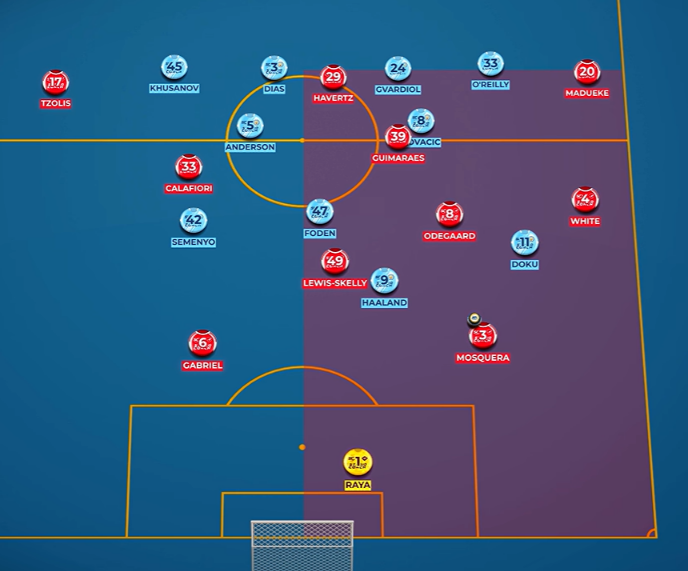
Arsenal’s attacking approach was based on creating advantages through movement rather than relying on individual actions alone.
Their midfielders rotated positions, their full-backs supported attacks from different areas and their wide players stretched the opposition.
The early movement from Calafiori into the half-space demonstrated how quickly Arsenal could exploit an available gap.
The attacking partnership between Calafiori and Tzolis also played an important role, with Tzolis providing the delivery for Havertz’s goal to make it 2-0.
These situations showed how Arsenal could use positional rotations to move defenders away from their preferred positions and create opportunities in dangerous areas.
9. What This Match Revealed About Both Teams
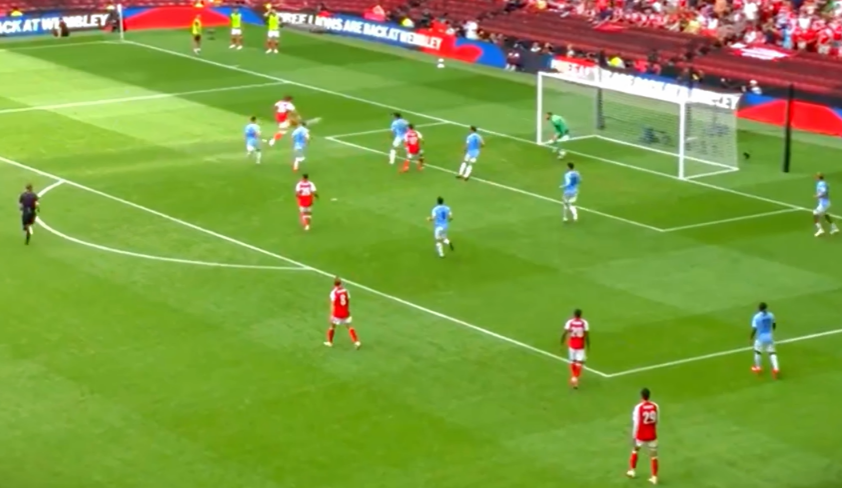
The Community Shield is not always a reliable prediction of what will happen throughout an entire Premier League season.
However, the match provided useful tactical information about the ideas both teams were developing.
For Arsenal, the performance highlighted the effectiveness of combining man-marking during the opposition’s build-up with a compact 4-4-2 defensive block.
Their attacking rotations also demonstrated how players such as Calafiori and Ødegaard could create advantages through intelligent positioning.
For Manchester City, the match exposed some problems with their ability to deal with organised pressing and midfield rotations.
The absence of Rodri was also an important issue to consider, particularly because the team needed a reliable central structure to support its possession game.
Finding the right balance in midfield would be an important challenge for City moving forward.
Frequently Asked Questions
How did Arsenal stop Manchester City’s build-up?
Arsenal used aggressive man-marking during City’s initial build-up, limiting the available passing options and forcing players into rushed decisions.
What formation did Arsenal use defensively?
Arsenal initially pressed in a man-oriented structure before dropping into a compact 4-4-2 mid-block when Manchester City progressed into midfield.
Why did Manchester City’s 3-1-3-3 formation struggle?
Although the formation created a numerical advantage in midfield, Arsenal’s compact defensive structure and coordinated shifting movements prevented City from exploiting that advantage consistently.
What was Calafiori’s tactical role?
Calafiori frequently moved inside into the left half-space, supporting the midfield and creating additional passing options while Tzolis provided width on the flank.
How did Arsenal create chances against Manchester City?
Arsenal used midfield rotations, overlapping full-backs and positional movements to create free players between the lines and in wide attacking areas.
Final Thoughts
Arsenal’s performance demonstrated how a well-organised defensive structure can limit the effectiveness of a possession-based team.
Their combination of aggressive man-marking, a compact 4-4-2 mid-block and intelligent midfield rotations made it difficult for Manchester City to find dangerous spaces.
At the same time, Arsenal showed how flexible attacking movements can create numerical advantages and expose weaknesses in an opponent’s defensive structure.
For Manchester City, the match highlighted the importance of finding solutions against coordinated pressing and improving their midfield balance.
Ultimately, the biggest lesson was that possession alone does not guarantee attacking control. The ability to protect space, coordinate defensive movements and exploit positional advantages can be just as important.