
Modern football is increasingly defined by aggressive pressing, intense individual battles and the ability to exploit small spaces before opponents can reorganise.
The clash between Paris Saint-Germain and Barcelona provided an excellent example of these tactical developments. Both teams relied on aggressive defensive principles, but their approaches were noticeably different.
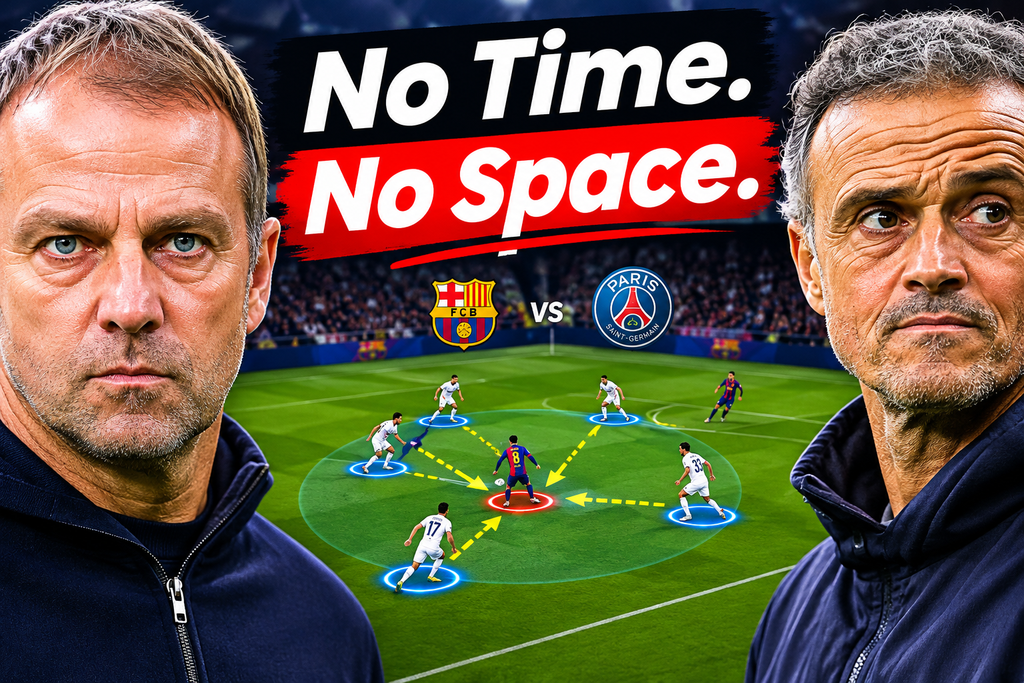
Barcelona focused more on maintaining their defensive structure and controlling space, while PSG used an aggressive man-marking system designed to follow opponents closely and disrupt their build-up play.
Despite having less possession, PSG created numerous dangerous opportunities and demonstrated that controlling the ball is not always necessary to control a football match.
Their performance highlighted several important lessons about modern football, including the effectiveness of man-marking, the importance of vertical movements and the growing influence of individual duels.
1. PSG and Barcelona: Two Different Pressing Philosophies
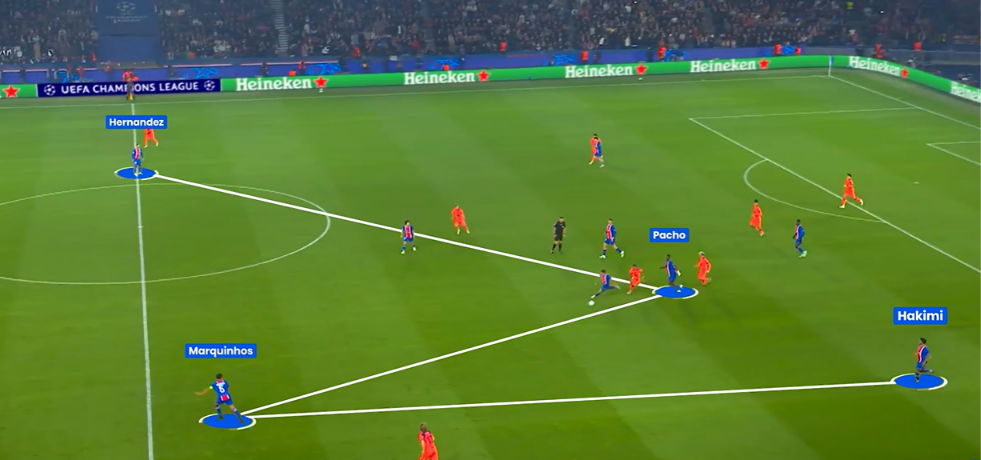
Both teams shared a fundamental tactical idea: press aggressively and react immediately when possession changes.
However, the way they applied this principle was very different.
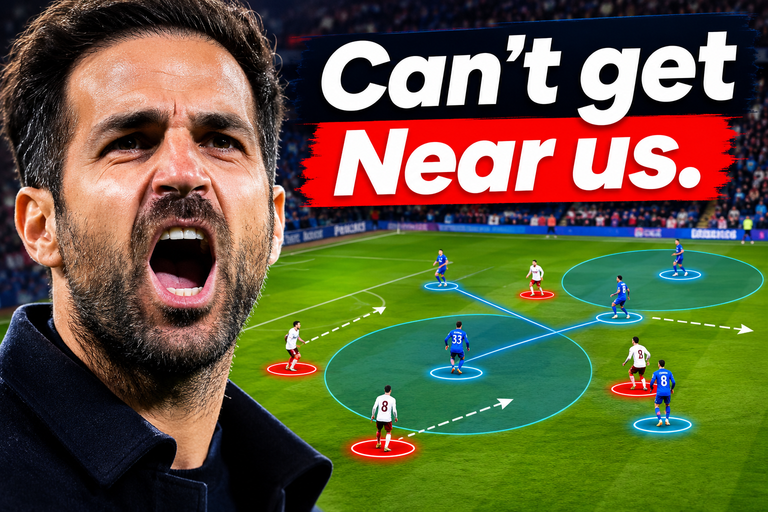
PSG preferred a man-oriented pressing system, where players followed their direct opponents across different areas of the pitch. Barcelona, meanwhile, focused more on maintaining their defensive structure and controlling specific zones.
These different approaches created an interesting tactical battle.
PSG attempted to prevent Barcelona from building attacks comfortably by putting pressure on individual players. Barcelona tried to maintain their defensive shape while closing passing lanes and forcing PSG towards the wider areas.
The effectiveness of these systems depended heavily on how well individual players performed their defensive responsibilities.
2. How PSG Used Man-Marking to Disrupt Barcelona
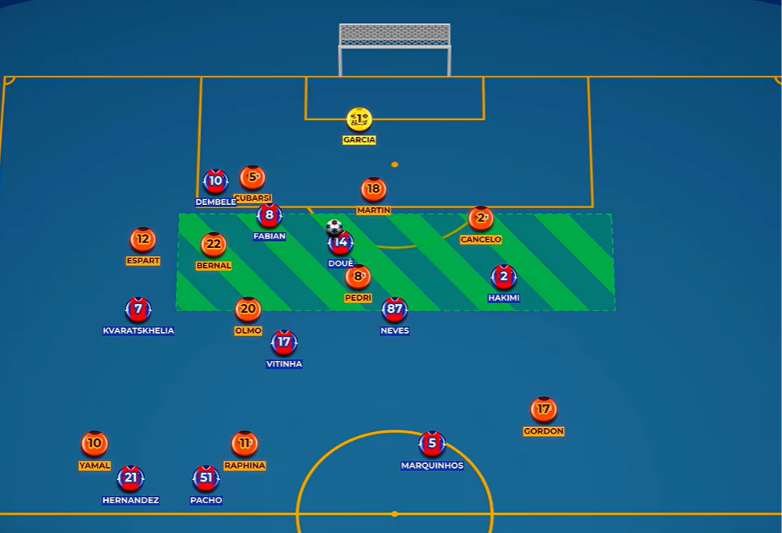
Under Luis Enrique, PSG demonstrated an aggressive approach to defending that focused on tracking opponents rather than simply protecting fixed positions.
Their pressing structure was designed to limit the passing options available to Barcelona’s players.
Even the centre-backs were willing to move forward into midfield when necessary, following their opponents and preventing them from receiving the ball comfortably.
This meant PSG did not always maintain a traditional defensive line.
Instead, their players adjusted their positions according to Barcelona’s movements.
Pressing From the Very Beginning
PSG’s aggressive intentions were visible from the opening moments.
They looked to apply immediate pressure high up the pitch, making it difficult for Barcelona to organise their build-up.
One early sequence demonstrated how effective this approach could be.
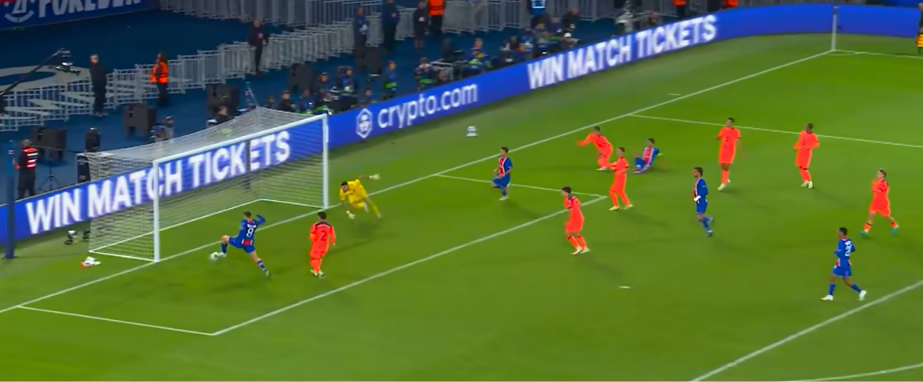
Barcelona attempted to progress the ball forward, but the receiving player had limited passing options. After the ball reached Pedri, João Neves immediately applied pressure and PSG recovered possession.
They quickly moved the ball towards Khvicha Kvaratskhelia near the edge of the penalty area, where his attempt struck the post.
This sequence showed how aggressive pressing can transform a defensive action into an immediate attacking opportunity.
3. Why PSG Created So Many Long-Range Shooting Opportunities
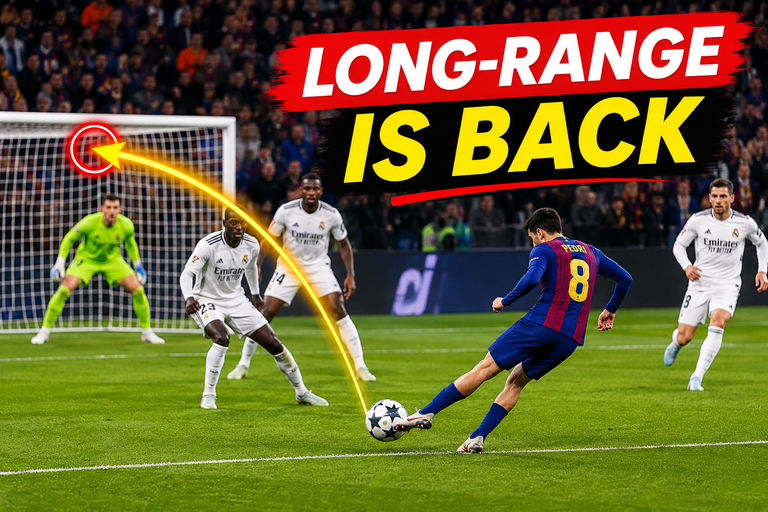
One of the most interesting aspects of the match was the number of shots taken from outside the penalty area.
According to the match statistics highlighted in the source analysis, PSG recorded 22 shots, with approximately 40% coming from outside the box.
Barcelona also attempted a significant number of long-range efforts, with around 30% of their shots coming from outside the penalty area.
These figures highlight an important tactical consequence of aggressive pressing.
When a team wins possession high up the pitch, the opposition’s midfield may not have enough time to recover into its defensive positions.
This creates valuable space in front of the defensive line.
Attackers can exploit that space through quick transitions, forward runs and long-range attempts before the defending team becomes organised again.
Long-range shooting is therefore not always the result of individual players taking unnecessary risks. It can also be a direct consequence of the spaces created by modern pressing systems.
4. PSG’s Aggressive Pressing Dominated the First Half
During the opening stages, Barcelona struggled to progress the ball consistently.
PSG continued tracking their opponents and applying pressure whenever Barcelona attempted to build attacks.
Their defensive organisation allowed them to close down central passing options while forcing Barcelona into difficult situations.
The midfielders were particularly important because they helped protect the central areas and supported the defenders when Barcelona attempted to move the ball forward.
PSG’s pressure also created opportunities to attack quickly.
When they intercepted a pass or forced Barcelona into a mistake, they immediately looked for forward movements that could expose the defensive line.
This approach became a major feature of the first half and played an important role in PSG’s opening goal.
5. How PSG Scored Their Opening Goal
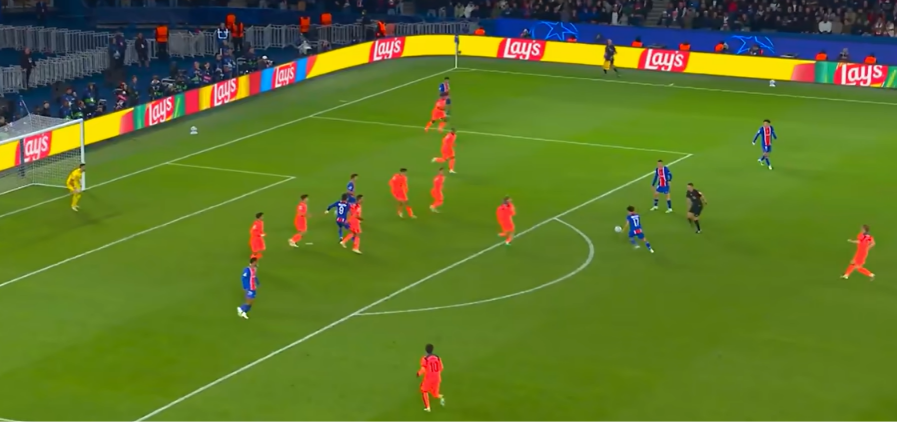
PSG’s opening goal illustrated the problems Barcelona faced against the aggressive pressing structure.
The move began with PSG applying pressure and tracking Barcelona’s attacking players.
Lamine Yamal moved towards the ball, attempting to create a passing option. However, after Barcelona’s initial combination, the wide attacking support was not positioned effectively.
This limited the available passing options and made it easier for PSG to continue applying pressure.
When Barcelona attempted another pass, PSG intercepted the ball.
Désiré Doué collected possession near the edge of the penalty area and finished the opportunity.
The goal demonstrated how a coordinated pressing system can punish even small mistakes during the build-up phase.
6. Barcelona’s Zonal Pressing and High Defensive Line
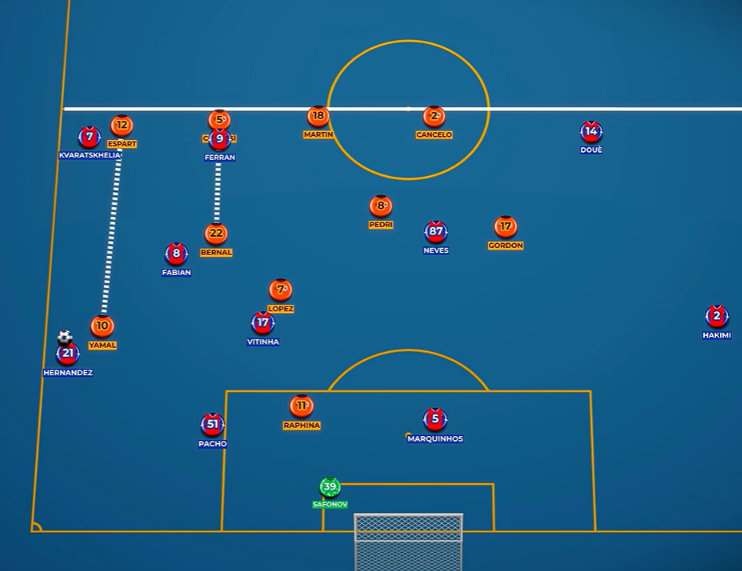
Barcelona also used an aggressive defensive approach, but their system was more focused on maintaining positional structure.
Rather than following every opponent across the pitch, they prioritised keeping their defensive line organised and protecting specific areas.
Their high defensive line helped compress the space between the defence and midfield.
This made it more difficult for PSG to receive the ball comfortably in central areas.
Barcelona also attempted to direct the opposition towards one side of the pitch, where they could close down passing options and apply pressure.
The Advantages of Barcelona’s Approach
A well-organised high line can provide several advantages:
- It reduces the space available between defensive lines.
- It helps the team maintain compactness.
- It allows midfielders to press opponents closer to the ball.
- It can make it easier to recover possession in advanced areas.
However, this approach also carries risks.
When defenders move forward to maintain a high line, spaces can appear behind them.
If opponents time their forward runs correctly, they can exploit these gaps and create dangerous attacking situations.
7. How Barcelona Found a Way to Beat PSG’s Man-Marking
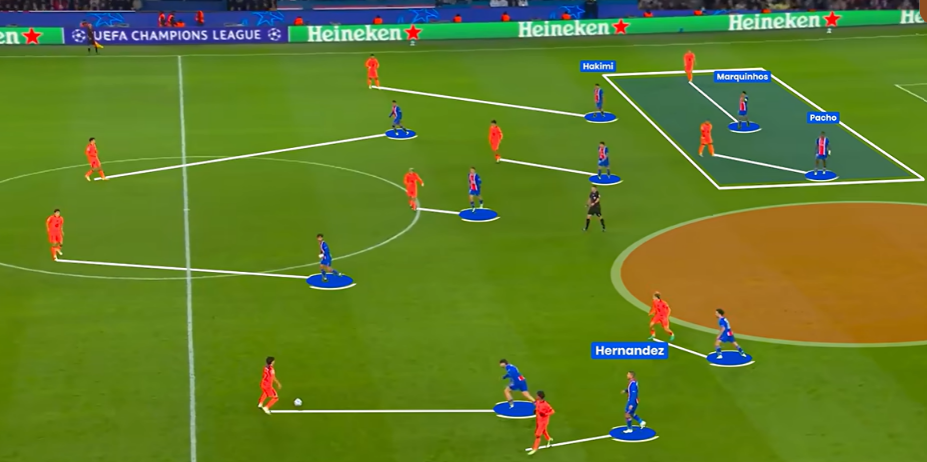
The second half provided another important tactical lesson.
As the intensity of PSG’s pressing decreased slightly, Barcelona found more opportunities to progress the ball.
One of the most effective ways to challenge man-marking systems is through positional rotations and vertical movements.
When players remain in fixed positions, defenders can follow them more easily.
However, when attackers constantly change positions and make forward runs, the defensive structure becomes more difficult to maintain.
Why Vertical Runs Matter
Vertical runs are movements made towards the opposition’s goal, often designed to exploit spaces behind defenders or between defensive lines.
These movements can force defenders into difficult decisions.
A defender following an opponent may leave space behind, while refusing to follow can allow the attacker to receive the ball freely.
Barcelona used this principle during their equalising goal.
The move began with possession being recovered high up the pitch.
As PSG’s defensive players tracked their opponents, space appeared behind the defensive structure.
Eric García’s movement into this area allowed Barcelona to exploit the gap and complete the attacking move.
This was a clear example of how coordinated movement can disrupt an aggressive man-marking system.
8. Individual Duels Are Becoming More Important in Modern Football
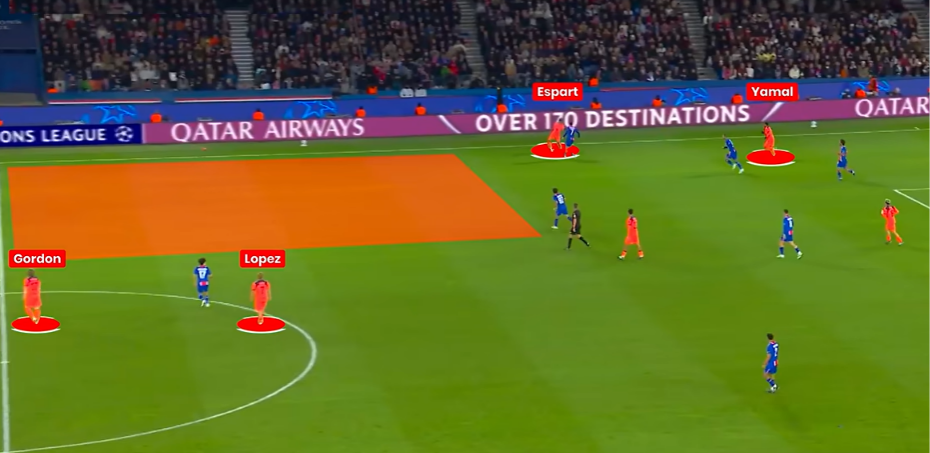
Another major lesson from the match was the importance of individual duels.
Modern football has become increasingly intense, with players required to make decisions quickly while dealing with direct opponents.
Man-marking systems can create situations where individual battles determine whether a team successfully progresses the ball or loses possession.
A midfielder may need to escape pressure from a direct opponent, while a defender must decide whether to follow an attacking player into midfield or protect the space behind.
These moments can have a major influence on the outcome of an attack.
Recognising Space and Winning Battles
Players must now understand not only their tactical responsibilities but also how to recognise opportunities created by opponents’ movements.
A successful dribble, a well-timed run or a quick positional rotation can be enough to create an advantage.
This explains why individual quality remains extremely important even within highly organised tactical systems.
The best teams combine collective organisation with players capable of winning decisive individual battles.
9. Why PSG Could Win Without Dominating Possession
Perhaps the biggest lesson from this match was that possession does not always determine which team controls a game.
Barcelona had more of the ball, but PSG still created significant attacking opportunities.
The match statistics highlighted in the source analysis showed PSG recording 22 shots and approximately 3.7 Expected Goals (xG).
This demonstrated the quality and quantity of the opportunities they created.
Their aggressive pressing helped them recover possession in dangerous areas, while quick transitions allowed them to attack before Barcelona could reorganise.
Rather than focusing on keeping the ball for long periods, PSG prioritised creating dangerous situations whenever opportunities appeared.
This is an important characteristic of modern football.
A team can have less possession but still produce more dangerous attacks through effective pressing, quick transitions and intelligent movement.
Frequently Asked Questions
How did PSG beat Barcelona tactically?
PSG used aggressive man-marking and high pressing to disrupt Barcelona’s build-up play. They also exploited spaces created when Barcelona lost possession.
What is man-marking in football?
Man-marking is a defensive approach in which players are assigned specific opponents to follow and prevent them from receiving or using the ball comfortably.
What is the difference between man-marking and zonal marking?
Man-marking focuses on tracking individual opponents, while zonal marking prioritises protecting specific areas of the pitch and maintaining defensive structure.
Why is vertical movement important against man-marking?
Vertical runs can create spaces behind defenders and force them to make difficult decisions about whether to follow opponents or protect their defensive positions.
Can a team dominate a match without having more possession?
Yes. A team can create more dangerous opportunities through pressing, counterattacks and quick transitions, even if its opponent controls more of the ball.
Final Thoughts
The PSG versus Barcelona clash demonstrated how modern football continues to evolve through aggressive pressing, individual duels and intelligent positional movements.
PSG showed the effectiveness of man-marking and high pressing, while Barcelona demonstrated how vertical runs and coordinated rotations can create opportunities against these systems.
The match also reinforced an important tactical principle: possession alone does not determine dominance.
In modern football, the ability to win the ball in dangerous areas, exploit available space and make the right decisions during individual battles can be just as important as controlling the game through possession.