

Arsenal left Lisbon with a narrow but valuable 1-0 advantage after defeating Sporting CP in the first leg of their UEFA Champions League quarter-final.
The scoreline may suggest a straightforward away victory, but the reality was a far more complex tactical battle. Sporting’s compact defensive structure caused Arsenal significant problems throughout the match, restricting central progression and forcing Mikel Arteta’s side to search for alternative routes towards goal.
While Arsenal enjoyed slightly more possession and territorial control, Sporting remained competitive and created several dangerous moments through direct attacks and intelligent movement in transition.
Ultimately, it took a moment of quality between two second-half substitutes, Gabriel Martinelli and Kai Havertz, to separate the teams.
Match Details
| Competition | UEFA Champions League Quarter-Final |
|---|---|
| Match | Sporting CP vs Arsenal |
| Venue | Estádio José Alvalade |
| Result | Sporting CP 0-1 Arsenal |
| Leg | First Leg |
Sporting’s Compact Shape Frustrated Arsenal
From the opening stages, Sporting made it clear they would not allow Arsenal easy access through central areas.
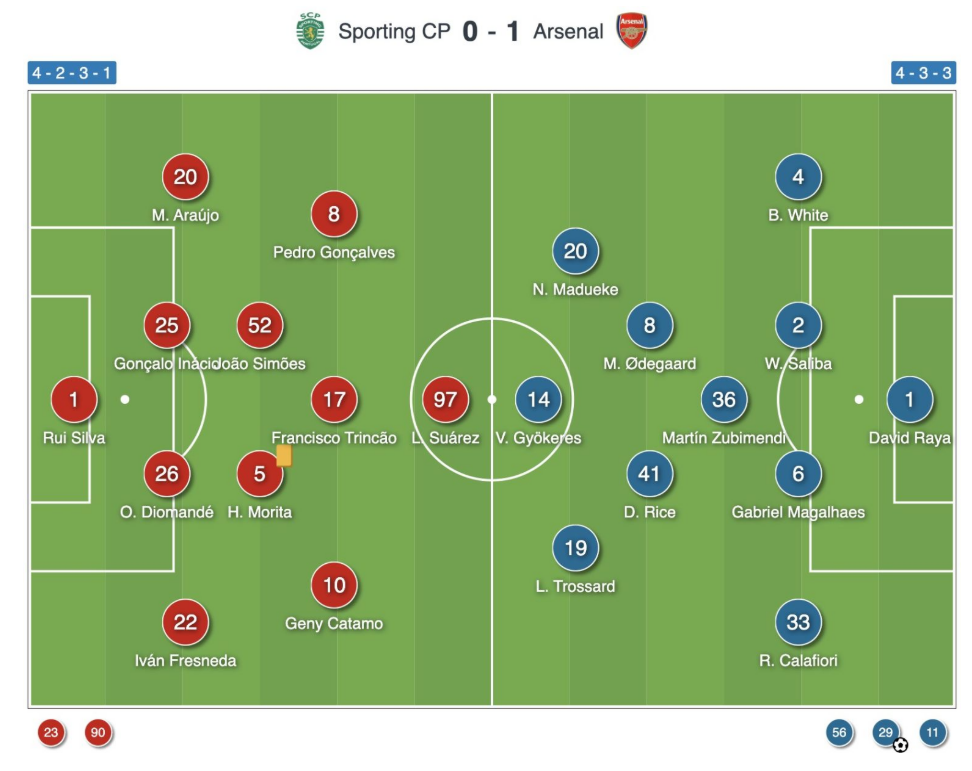
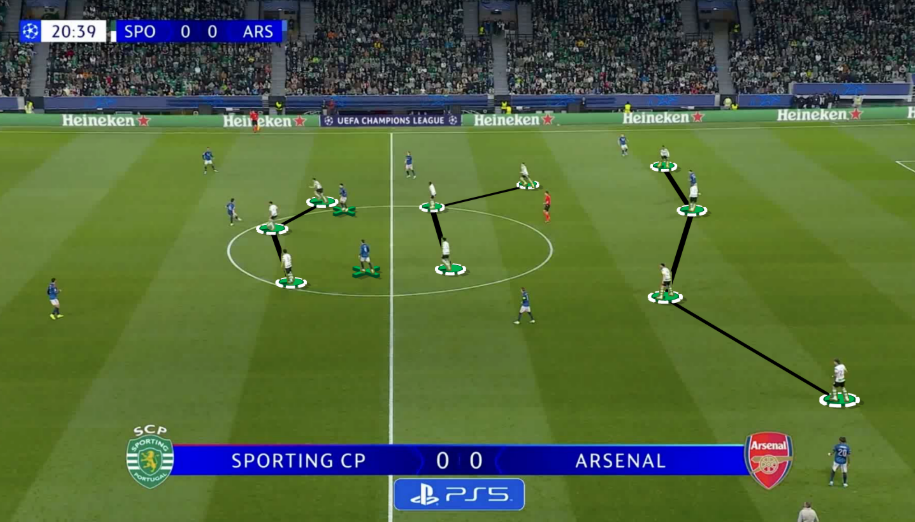
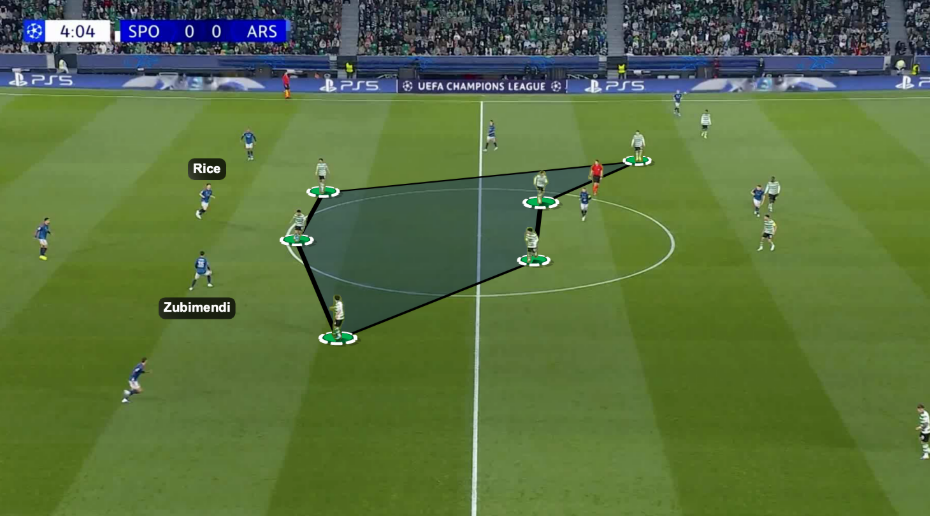
Rui Borges organized his team in a disciplined 4-2-3-1 structure that frequently transformed into a compact 4-3-3 mid-block. The front three remained narrow, blocking passing lanes towards Martín Zubimendi and Declan Rice while forcing Arsenal to circulate possession towards the flanks.
This defensive organization disrupted Arsenal’s usual rhythm.
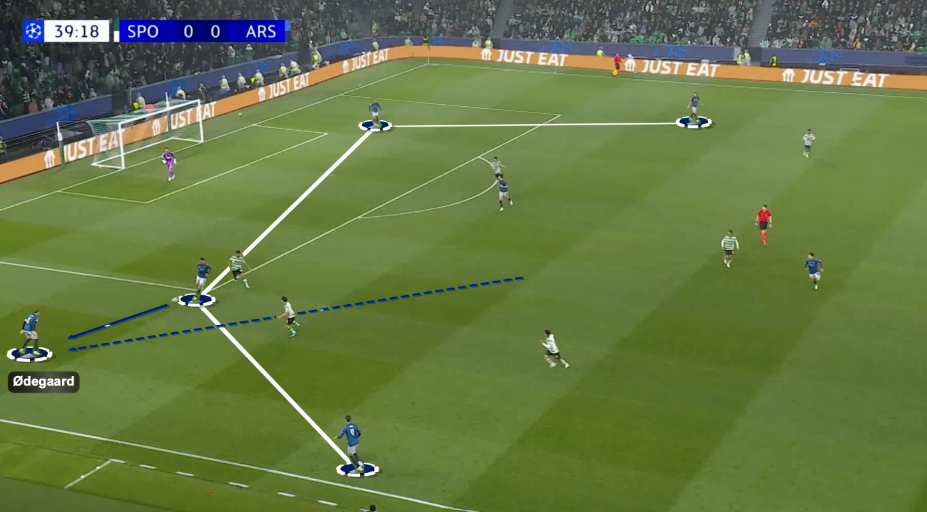
Martin Ødegaard often dropped deep in search of the ball, but doing so left Viktor Gyökeres isolated higher up the pitch. As a result, Arsenal frequently controlled possession without creating meaningful penetration.
The Gunners were forced to attack around Sporting’s defensive block rather than through it.
Arsenal Struggled To Find Central Progression
One of Arsenal’s biggest problems throughout the match was their inability to consistently connect midfield with attack.
Sporting’s compact positioning prevented line-breaking passes and limited the influence of Arsenal’s central midfielders. Whenever Rice or Zubimendi attempted to receive between the lines, Sporting immediately collapsed around the ball.
This forced Arsenal to rely heavily on wide areas.
Ben White and Riccardo Calafiori regularly pushed forward in an attempt to stretch Sporting’s shape, while Trossard and Madueke looked to isolate defenders in one-versus-one situations.
Although these movements occasionally created dangerous situations, the final pass or finishing touch was often missing.
Sporting Threatened Through Direct Attacks
Despite spending long periods without possession, Sporting created several dangerous moments of their own.
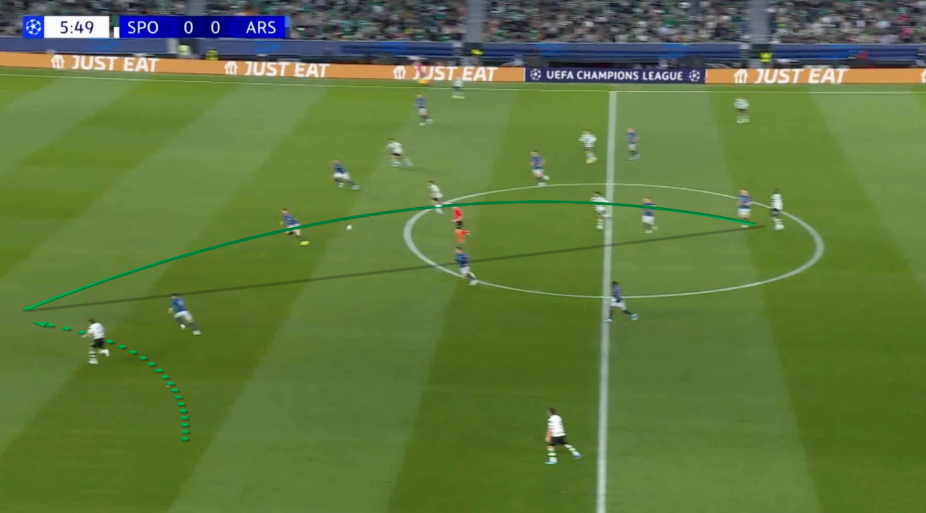
Rather than patiently building attacks, the Portuguese side frequently looked to exploit the space behind Arsenal’s defensive line through direct passing.
Long diagonal balls and aggressive runs from wide players repeatedly tested Arsenal’s defensive organization.
There were moments when Arsenal’s midfield dropped slower than their defensive line, creating temporary gaps between the units. Sporting exploited those spaces well and generated some of their best chances through quick transitions.
Although they failed to score, they demonstrated enough attacking threat to keep Arsenal uncomfortable throughout the evening.
Arsenal’s Defensive Structure Kept Them Alive
While Arsenal lacked creativity at times, their defensive performance was outstanding.
Arteta’s side maintained a compact 4-4-2 shape both when pressing high and when defending deeper.
The wingers tucked inside to protect central areas while the midfield remained narrow, forcing Sporting towards the flanks where Arsenal could create numerical superiority.
Whenever Sporting attempted combinations in wide zones, Arsenal reacted aggressively by overloading the area around the ball and cutting off forward passing options.
This defensive discipline prevented Sporting from sustaining pressure and ultimately preserved the clean sheet.
Martinelli and Havertz Deliver the Decisive Moment
As the game entered its final stages, Arteta introduced Gabriel Martinelli and Kai Havertz in search of a breakthrough.
The move changed the dynamic of Arsenal’s attack.
Havertz occupied more advanced positions than Ødegaard had earlier in the match, providing an additional runner beyond the defensive line.
The winning goal perfectly illustrated Arsenal’s attacking principles.
The move began with quick circulation before Martinelli received possession on the flank. As Sporting defenders shifted towards him, Declan Rice’s movement dragged another defender away from the center.
At the same time, Gyökeres occupied a center-back near the ball.
This created the space Havertz needed to attack the channel unnoticed.
Martinelli delivered an excellent chipped pass and Havertz calmly controlled before finishing past Rui Silva.
It was a goal built on movement, timing, and intelligent positioning.
Tactical Verdict
Sporting deserve credit for making life extremely difficult for Arsenal.
Their defensive organization restricted central progression and forced the visitors into uncomfortable attacking patterns for much of the game.
However, Arsenal’s defensive solidity proved equally impressive.
Arteta’s side remained compact without the ball, controlled transitions effectively, and eventually found the decisive moment through their superior quality in the final third.
The tie remains far from over, but Arsenal will be delighted to return to London with both a clean sheet and a first-leg advantage.
Conclusion
This was not Arsenal’s most fluid attacking performance, but it was another example of a team capable of winning in different ways.
Sporting’s defensive structure disrupted many of Arsenal’s usual mechanisms, yet the Premier League side remained patient and disciplined throughout the contest.
A single moment of quality ultimately decided the match, giving Arsenal a valuable 1-0 victory and placing them in a strong position ahead of the return leg at the Emirates Stadium.