

Napoli secured a crucial 1-0 victory over AC Milan at the Stadio Diego Armando Maradona in a match that carried enormous importance in the battle for second place in Serie A.
While the scoreline may suggest a tight and uneventful contest, the reality was very different. The game was filled with tactical adjustments, positional battles, and contrasting attacking ideas from two coaches known for their strategic approach.
For long periods, both teams managed to neutralize each other’s strengths. Milan successfully disrupted Napoli’s usual attacking patterns, while Napoli struggled to translate possession into clear-cut opportunities.
However, Antonio Conte’s second-half adjustments eventually shifted the momentum of the game and proved decisive in securing all three points.
Match Details
| Competition | Serie A 2025/26 |
|---|---|
| Match | Napoli vs AC Milan |
| Venue | Stadio Diego Armando Maradona |
| Result | Napoli 1-0 AC Milan |
| Matchday | Round 31 |
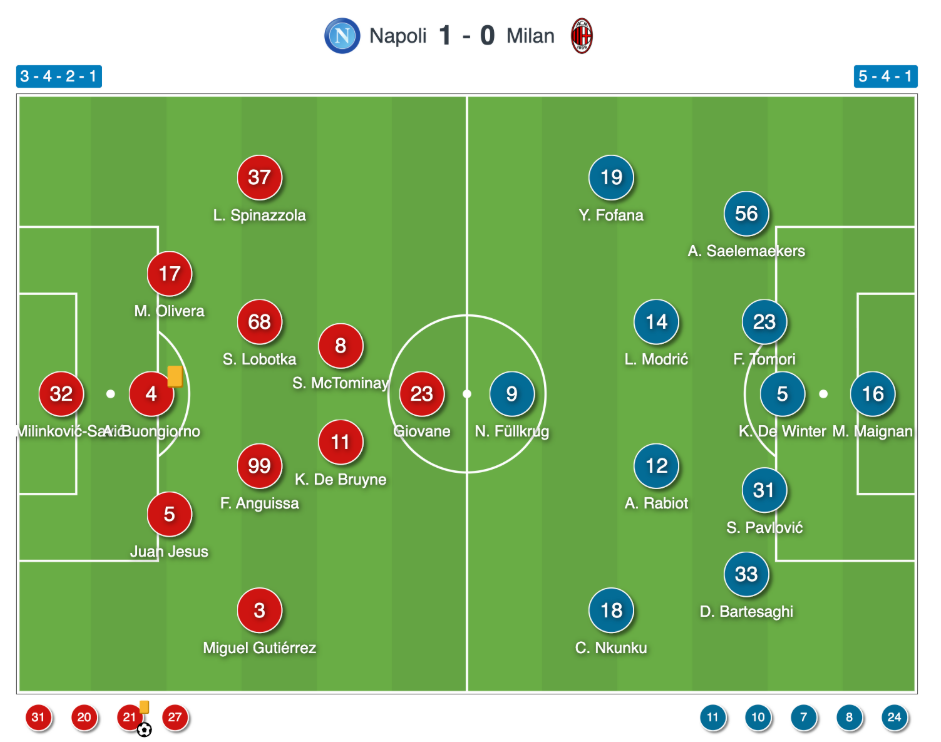
Napoli’s Mobile Striker Approach Created New Attacking Dynamics
Without a traditional target man available, Napoli were forced to modify their attacking structure.
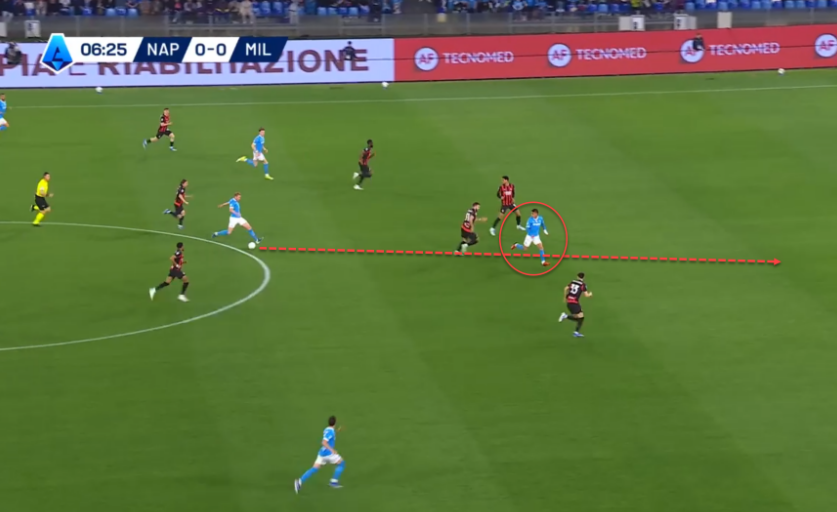
Rather than asking Giovane to operate as a fixed striker, Conte built the attacking system around movement and depth. Giovane constantly attacked the space behind Milan’s defensive line, while Kevin De Bruyne and Scott McTominay looked for opportunities to release him through vertical passes.
The objective was clear: avoid direct duels with Milan’s center-backs and instead exploit the spaces appearing behind them.
Several of Napoli’s most dangerous attacks during the first half came from this mechanism. Although the execution was not always perfect, the idea repeatedly caused problems for Milan’s defensive structure.
Milan’s Defensive Flexibility Neutralized Napoli
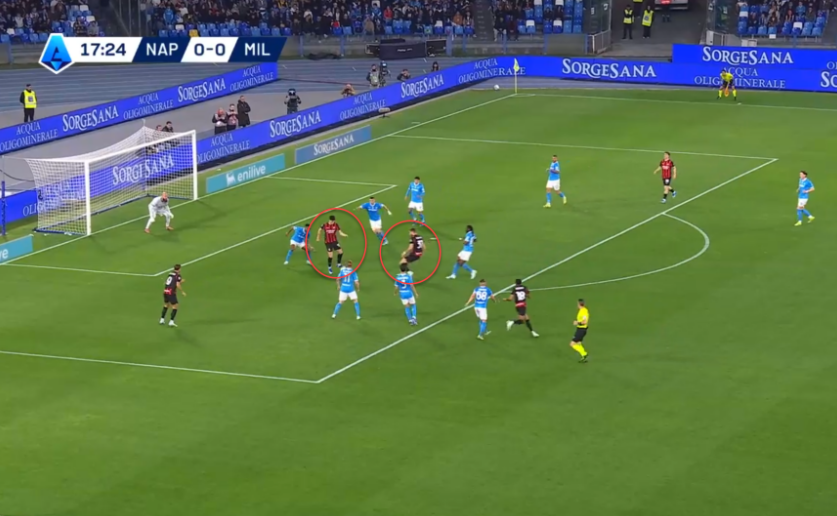
Massimiliano Allegri responded intelligently.
Out of possession, Milan often transformed their 3-5-2 shape into a compact 4-5-1 block. Christopher Nkunku frequently dropped deeper on the left side, helping Milan crowd central areas and prevent Napoli from creating numerical superiority in midfield.
This adjustment limited De Bruyne’s influence and forced Napoli into less effective attacking routes.
At the same time, Milan remained dangerous in transition. Their quick passing combinations allowed them to bypass Napoli’s pressure on several occasions.
However, while Milan progressed the ball well, they lacked efficiency inside the penalty area.
Why The Match Changed After Half-Time
The biggest tactical shift came after the break.
Conte recognized that Napoli’s attacks had become too predictable. The vertical passes toward Giovane remained useful, but Milan’s defenders gradually adapted.
Instead of persisting with the same approach, Napoli introduced greater movement across the front line.
Giovane began drifting wider, forcing Milan’s center-backs to leave their positions more frequently. This created larger spaces between defenders and improved Napoli’s ability to progress attacks into dangerous zones.
The home side became significantly more threatening as a result.
Conte’s Tactical Substitutions Break Milan’s Resistance
The decisive moment came when Conte introduced Matteo Politano and Alisson Santos.
The structure immediately changed.
McTominay moved into a false-nine role, while Politano and Santos attacked from wide positions. Napoli now had greater ability to isolate defenders in one-versus-one situations.
The winning goal perfectly illustrated the success of these changes.
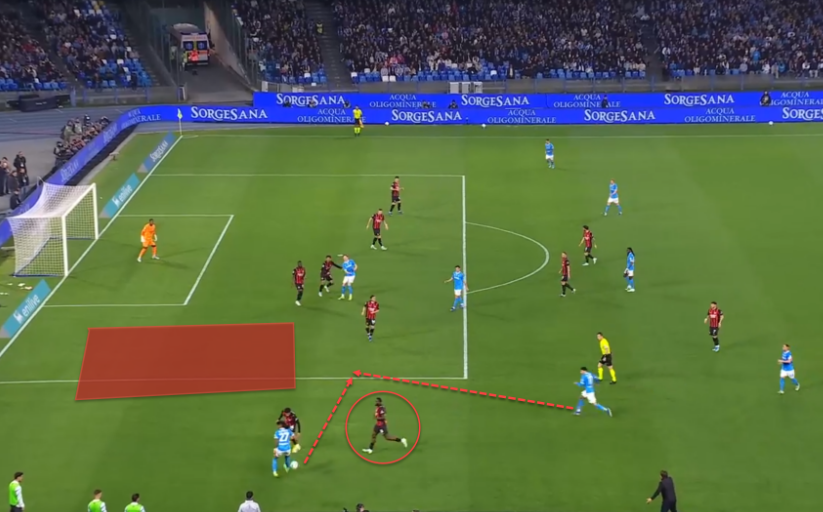
Santos attracted multiple Milan defenders, creating space for Mathías Olivera to advance through the half-space. The wing-back delivered a dangerous cross towards the far post, where Politano reacted quickest to score.
It was not a random goal.
It was the direct consequence of a carefully constructed tactical adjustment.
Tactical Verdict
This match was ultimately decided by adaptability.
For much of the evening, both teams were evenly matched. Milan defended well and created several promising transitions, but their finishing let them down.
Napoli, meanwhile, struggled initially but showed a greater capacity to evolve during the match.
Conte identified the problem, altered the structure, introduced fresh attacking profiles, and created the conditions for the winning goal.
That tactical flexibility proved to be the difference.
Conclusion
Napoli’s 1-0 victory was not built on overwhelming dominance but on intelligent in-game management.
Antonio Conte’s adjustments transformed a balanced tactical battle into a winning performance, while Milan were left frustrated by missed opportunities and a lack of cutting edge in the final third.
The result moves Napoli into second place and strengthens their position in the race for Champions League qualification, while Milan’s hopes of challenging for the Scudetto have effectively come to an end.