
The 2026-27 football season is bringing one of the biggest collections of rule changes in recent memory.
After being introduced during the 2026 FIFA World Cup, several new laws are now being implemented across English football, including the Premier League, EFL, Community Shield and lower-level competitions.
The central idea is simple: keep the ball in play for longer and reduce deliberate timewasting.
From five-second countdowns at restarts to stricter rules for substitutions and injured players, teams that have traditionally relied on slowing games down will have to adapt quickly.
VAR is also expanding into a few new situations, although several controversial World Cup interventions will not be introduced in England.
Here’s everything you need to know about the new football rules for the 2026-27 season.
Quick Overview
| Rule Change | What It Means |
|---|---|
| Goal-kicks | Goalkeepers can concede a corner for excessive delays |
| Throw-ins | Five-second countdown can be introduced |
| Substitutions | Players have 10 seconds to leave the pitch |
| Injuries | Treated players generally stay off for one minute |
| Goalkeeper timeouts | A teammate must leave the pitch for one minute |
| Goal-kick handling | Clearer rules for defenders handling the ball |
| VAR | Expanded into several new situations |
| Tactical timewasting | More aggressively discouraged |
The changes are designed to increase playing time without simply adding huge amounts of stoppage time. At the 2026 World Cup, the ball was in play for 60.43% of total match time, compared with 56.86% at the 2022 tournament.
Five-Second Countdown for Throw-Ins

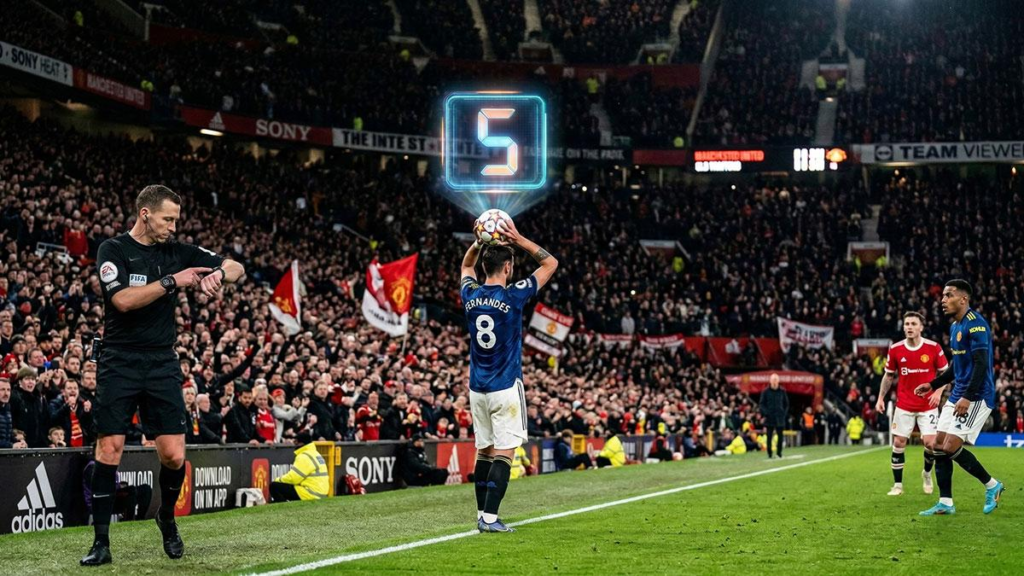
One of the most visible changes concerns throw-ins.
The countdown does not automatically begin the moment the ball leaves the pitch.
Instead, the referee can intervene when a player is deliberately delaying the restart.
This could include tactics such as:
- Leaving the ball in a particular position.
- Dropping the ball for a teammate.
- Deliberately disrupting the restart.
- Taking excessive time to prepare for the throw.
The referee will signal the start of the five-second countdown and visibly count down using an arm movement.
If the player fails to restart play before the countdown expires, the throw-in is awarded to the opposition.
There is an important exception for long throws.
A team can still take time to organize a genuine long-throw routine, although the countdown may begin once the players are ready.
Goalkeepers Can Now Give Away a Corner for Timewasting
Goalkeepers have long been able to slow matches down by taking an excessive amount of time over goal-kicks.
The new rules introduce a much stronger deterrent.
If a goalkeeper takes too long to restart play, the referee can award a corner kick to the opposition.
That could create some fascinating late-game situations.
Imagine a team leading 1-0 in the 89th minute.
The goalkeeper normally wants to squeeze every possible second from the clock.
Under the new rules, doing that could actually hand the opposition a dangerous corner.
The incentive has therefore changed completely.
Substituted Players Have 10 Seconds to Leave
This could become one of the most important changes during tight Premier League matches.
A substituted player now has 10 seconds to leave the pitch at the nearest point.
If they deliberately take too long:
- The substitute cannot immediately enter.
- The team must temporarily play with 10 players.
- The substitute has to wait until the next stoppage before entering.
The rule has already been tested in the Carabao Cup.
Middlesbrough forward Will Lankshear became the first player to be punished under the new rule after taking too long to leave the field while celebrating with supporters.
There are exemptions for situations such as injuries and security concerns.
But the days of slowly walking toward the halfway line while applauding every stand could be numbered.
Injured Players Must Stay Off for One Minute
Another significant change concerns injuries.
Previously, players who received treatment were generally required to remain off the pitch for around 30 seconds.
That period has now increased to one minute.
The rule is also designed to prevent players from using minor injuries to deliberately interrupt the opponent’s momentum.
If the referee stops the game because of an injury, the player generally has to leave the field.
There are exceptions, including situations where the injury resulted from a foul and the offending player receives a yellow or red card.
That prevents a team from effectively being punished twice for an opponent’s bad challenge.
Goalkeeper Tactical Timeouts Are Under Threat

6
One of the more controversial timewasting tactics in recent seasons has involved goalkeepers going down apparently injured.
The goalkeeper receives treatment.
Players gather around the manager.
Instructions are delivered.
Then, moments later, the goalkeeper suddenly appears ready to continue.
The new rules are specifically designed to discourage this tactic.
If a goalkeeper requests treatment, an outfield player selected by the coach must leave the pitch for one minute.
The team has 10 seconds to tell the fourth official which player will leave.
If they fail to do so, the captain must make the decision.
The idea is to ensure that a goalkeeper cannot simply create a free tactical timeout without consequences.
There are exemptions for genuine situations such as a goalkeeper being fouled or suffering bleeding.
A New Rule for Handling the Ball During Goal-Kicks
This is one of the more technical changes, but it could produce some interesting penalty-area incidents.
Teams increasingly use short goal-kicks, with defenders positioned inside the penalty area rather than the goalkeeper simply kicking the ball long.
That has previously created confusion over exactly when the goal-kick has been completed.
Under the new interpretation, the goal-kick is considered taken once the goalkeeper or defender kicks the ball.
If a defender subsequently handles the ball with their hand or arm, the referee can award a penalty.
If the goalkeeper handles it, the restart can instead be an indirect free-kick for a backpass.
The objective is to create a consistent interpretation across competitions.
VAR Is Expanding, But Not Everywhere

There are also several changes involving VAR.
However, the Premier League will not adopt every VAR intervention used during the World Cup.
Second Yellow Cards
VAR can now review the second yellow card when it results in a red card.
However, VAR cannot simply review every potential second booking.
The intervention must involve a clear error, rather than simply a different interpretation of a challenge.
Fouls Before Set-Pieces
VAR can also be used during a trial when an attacking foul occurs before a set-piece and directly contributes to:
- A goal.
- A penalty.
- A disciplinary sanction.
If the decision is overturned, the corner can be retaken.
The logic is that a free-kick cannot be awarded for an incident that happened before the ball was in play.
Mistaken Identity
VAR can intervene when the referee has punished the wrong player.
For example, if Team A is penalized for handball but the actual handball was committed by Team B, VAR can correct the identity of the player involved.
This is not intended to create a general VAR review system for simulation.
What VAR Will NOT Review

Some World Cup rule changes will not be used in English football.
There will be no VAR interventions for:
- Incorrectly awarded corners.
- Players covering their mouths during confrontational situations.
That means the Premier League will still maintain a relatively narrow VAR intervention framework compared with some of the experiments seen during the World Cup.
Why These Changes Matter
The new rules are not simply about punishing players.
The wider objective is to change behavior.
Football authorities want teams to understand that deliberately slowing down the game could eventually hurt them.
A goalkeeper wasting time might concede a corner.
A substitute walking slowly off could leave his team temporarily with 10 players.
A player repeatedly using an injury to interrupt play could force his team to play a man down.
The message is becoming increasingly clear:
If you waste time, there could be an immediate competitive cost.
Which Teams Could Be Most Affected?
Teams that regularly defend narrow leads could face the biggest adjustment.
Late-game management has always been part of football.
But there is a difference between intelligent game management and deliberately preventing the game from restarting.
The new laws target the latter.
Managers will therefore need to rethink how they use substitutions, goalkeeper treatment and restarts during the final stages of matches.
The Biggest Rule Changes at a Glance
| Situation | New Rule |
|---|---|
| Delayed throw-in | Five-second countdown |
| Delayed goal-kick | Opposition can receive a corner |
| Slow substitution | Substitute waits and team temporarily plays with 10 |
| Player receives treatment | Generally one-minute absence |
| Goalkeeper treatment | Selected teammate leaves for one minute |
| Defender handles after goal-kick | Penalty |
| Second-yellow red card | VAR can review clear errors |
| Attacking foul before set-piece | VAR trial in certain situations |
| Wrong player punished | VAR can correct mistaken identity |
Key Takeaways
- The 2026-27 season introduces several new rules designed to reduce timewasting.
- Players delaying throw-ins can face a five-second countdown.
- Goalkeepers can concede a corner for excessive delays over goal-kicks.
- Substituted players have 10 seconds to leave the field.
- Players receiving treatment generally have to remain off for one minute.
- Goalkeeper tactical timeouts are being specifically targeted.
- Goal-kick handling situations now have a clearer interpretation.
- VAR has been expanded into several new areas.
- Incorrect corners and confrontational mouth-covering incidents will not receive VAR intervention.
- The changes are designed to increase the amount of football played without relying heavily on additional stoppage time.
Final Thoughts
The 2026-27 season could feel noticeably different even before the first major tactical trend emerges.
The biggest change may not actually be the number of yellow cards or VAR checks. It could be the gradual disappearance of those little interruptions that have become part of modern football: the goalkeeper taking forever over a goal-kick, the substitute taking the scenic route to the touchline, or the conveniently timed injury that kills an opponent’s momentum.
The new laws are essentially trying to make those behaviors less attractive.
Whether they improve the rhythm of matches remains to be seen, but one thing is certain: timewasting just became a much riskier game.