
Modern football analysis goes far beyond goals, possession, and shots. Coaches and analysts now rely on advanced metrics to better understand how teams control matches, create pressure, and dominate territory. One of the most useful of these statistics is Field Tilt.
Unlike possession, which measures how much a team has the ball overall, Field Tilt focuses on where a team controls the game. It reveals which side spends more time attacking and applying pressure in dangerous areas of the pitch.
In this guide, we’ll explain what Field Tilt is, how it’s calculated, why it matters, and how it helps analysts evaluate team performances.
What Is Field Tilt?
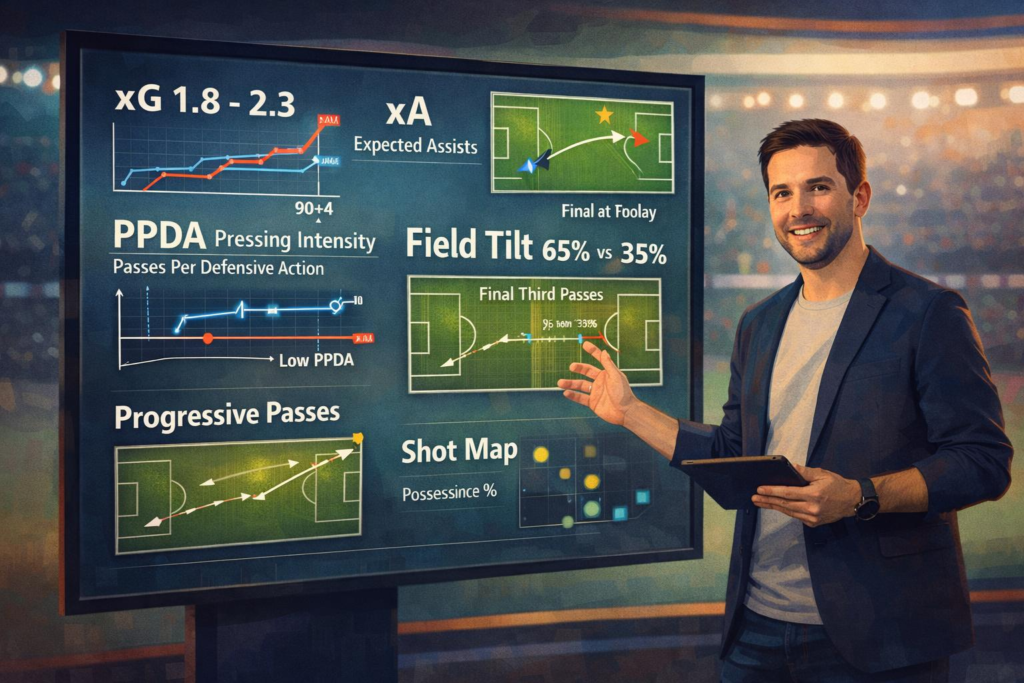
Field Tilt is a football statistic that measures a team’s share of possession or passes in the attacking third of the pitch.
Instead of counting every pass equally, it looks specifically at which team controls possession near the opponent’s goal.
In simple terms:
- A high Field Tilt means a team spends more time attacking.
- A low Field Tilt means a team spends more time defending.
This makes it an excellent indicator of territorial dominance.
How Is Field Tilt Calculated?
Although different analytics providers may use slightly different formulas, the basic idea is simple.
The calculation compares the number of passes made by both teams in the attacking third.
Example:
| Team | Passes in Final Third |
|---|---|
| Team A | 180 |
| Team B | 60 |
Field Tilt for Team A:
180 ÷ (180 + 60) = 75%
This means Team A controlled 75% of the attacking-third possession.

Why Field Tilt Matters
Possession alone doesn’t always tell the full story.
A team can keep the ball safely in its own half without creating much danger.
Field Tilt answers more important tactical questions such as:
- Which team spent more time attacking?
- Who controlled the opponent’s half?
- Which side applied sustained pressure?
- Which team forced the opposition deeper?
Because of this, many analysts consider Field Tilt more informative than possession percentage alone.
Field Tilt vs Possession
These two statistics are often confused, but they measure different aspects of a match.
| Statistic | Measures |
|---|---|
| Possession | Overall control of the ball |
| Field Tilt | Control in attacking areas |
For example:
- Team A may have 48% possession.
- But if most of that possession occurs near the opponent’s penalty area, they could still record a high Field Tilt.
This demonstrates why territory can be just as important as possession.
What Does a High Field Tilt Mean?
Teams with a high Field Tilt usually:
- Keep opponents pinned back
- Spend long periods attacking
- Sustain pressure around the penalty area
- Win possession quickly after losing the ball
- Generate repeated attacking opportunities
High Field Tilt is often associated with proactive, possession-based football.
What Does a Low Field Tilt Mean?
A lower Field Tilt doesn’t automatically indicate poor performance.
Some teams intentionally:
- Defend deep
- Stay compact
- Invite pressure
- Attack on the counter
- Protect a lead
A low Field Tilt may simply reflect a tactical approach designed to exploit space on the break.

Which Teams Often Record High Field Tilt?
Several elite clubs have regularly produced strong Field Tilt numbers thanks to their attacking philosophy.
Teams known for dominating territory often:
- Press aggressively after losing possession.
- Build attacks patiently.
- Keep defensive lines high.
- Maintain sustained possession in the final third.
This style makes it difficult for opponents to escape their own half.
Field Tilt and Pressing
Field Tilt is closely connected to pressing intensity.
When teams recover possession quickly after losing the ball, they often remain in advanced areas rather than retreating into their own half.
This leads to:
- More attacking-third passes
- Longer attacking sequences
- Increased territorial control
- Higher Field Tilt percentages
For this reason, analysts often study Field Tilt alongside pressing metrics such as PPDA.
Field Tilt Isn’t Everything
Although it’s an excellent measure of territorial dominance, Field Tilt has limitations.
A team can dominate territory but still:
- Create few clear chances
- Miss good opportunities
- Struggle to break down organized defenses
- Lose on the counterattack
Likewise, a team with a lower Field Tilt can win comfortably by finishing its chances efficiently.
No single statistic tells the complete story.

Statistics Commonly Used With Field Tilt
Analysts usually combine Field Tilt with other metrics to gain a fuller understanding of a match.
| Metric | Purpose |
|---|---|
| Expected Goals (xG) | Chance quality |
| Possession | Ball control |
| PPDA | Pressing intensity |
| Progressive Passes | Forward progression |
| Progressive Carries | Ball advancement |
| Shot-Creating Actions | Build-up effectiveness |
| Touches in Opposition Box | Final-third threat |
Looking at these numbers together provides a much clearer picture than relying on one statistic alone.
Why Coaches Use Field Tilt
Coaching staffs use Field Tilt to evaluate tactical performance across an entire match.
It helps them:
- Measure territorial dominance
- Assess attacking pressure
- Compare performances between matches
- Analyze opponents
- Improve pressing strategies
- Identify periods of sustained control
Tracking Field Tilt over a season can also reveal whether a team’s playing style is becoming more aggressive or more defensive.
Final Thoughts
Field Tilt has become one of the most valuable metrics in modern football analytics because it focuses on where possession happens rather than simply how much possession a team has. By measuring control in the attacking third, it offers valuable insight into territorial dominance, sustained pressure, and attacking intent.
While it shouldn’t be viewed in isolation, Field Tilt becomes a powerful analytical tool when combined with statistics like possession, Expected Goals (xG), and PPDA. For fans interested in the tactical side of football, understanding Field Tilt provides a deeper appreciation of how elite teams control matches long before the final whistle.