

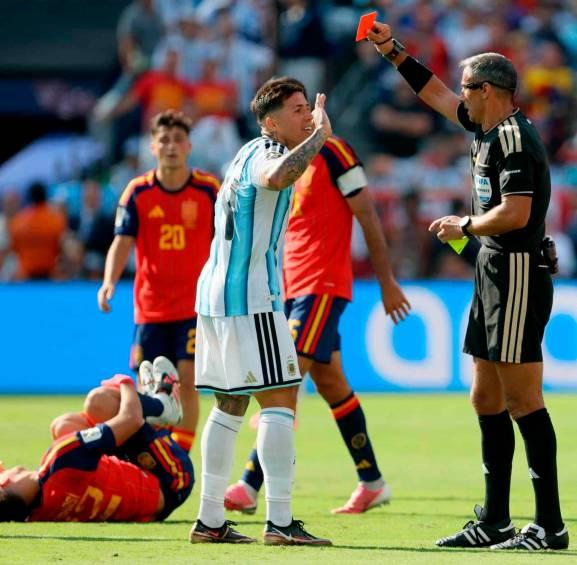
Argentina’s painful 1-0 defeat to Spain in the 2026 FIFA World Cup Final was made even more dramatic by one decisive moment that changed the course of the match.
Midfielder Enzo Fernández was sent off late in normal time after picking up two yellow cards within just 11 minutes. The dismissal left Argentina with ten players for extra time and helped create an unwanted piece of World Cup history.
Already under sustained pressure from Spain’s possession-based attack, Lionel Scaloni’s side faced an even tougher challenge after the red card. Ferran Torres eventually broke the deadlock in the 106th minute to hand Spain their second FIFA World Cup title.
Match Overview
| Detail | Information |
|---|---|
| Competition | FIFA World Cup 2026 Final |
| Result | Spain 1-0 Argentina (AET) |
| Venue | MetLife Stadium |
| Winning Goal | Ferran Torres (106′) |
| Red Card | Enzo Fernández |
| Referee | Slavko Vinčić |
How Enzo Fernández Was Sent Off
For much of the final, Argentina defended deep while trying to frustrate Spain’s patient build-up play.
Late in the second half, Fernández received his first yellow card after protesting a refereeing decision.
Just minutes later, the Chelsea midfielder attempted to stop a dangerous Spanish counterattack with a late challenge on Pau Cubarsí near the halfway line.
Referee Slavko Vinčić immediately produced a second yellow card, followed by the inevitable red.
Argentina were forced to play the remainder of the match with ten men, dramatically increasing the physical demands on a side already spending long periods without possession.

Argentina Make Unwanted World Cup Final History
Fernández’s sending-off also carried historical significance.
With his dismissal, Argentina became the nation with the most player dismissals in FIFA World Cup Final history.
Argentina’s World Cup Final Red Cards
| Player | Final | Opponent |
|---|---|---|
| Pedro Monzón | 1990 | West Germany |
| Gustavo Dezotti | 1990 | West Germany |
| Enzo Fernández | 2026 | Spain |
No other nation has accumulated three red cards in World Cup finals.
It is a record Argentina would undoubtedly prefer not to own.
Moving Ahead of France
Before the 2026 final, Argentina shared this unfortunate statistic with France.
France’s previous World Cup Final dismissals included:
- Marcel Desailly (1998)
- Zinedine Zidane (2006)
Fernández’s red card moved Argentina alone to the top of this unwanted list.
World Cup finals often come down to discipline as much as quality, and Argentina paid a heavy price for one costly mistake.
Spain Took Full Advantage
Although Spain had already controlled much of the match, playing against ten men allowed Luis de la Fuente’s side to increase the pressure even further.
Eventually the breakthrough arrived.
A cross into the penalty area reached Nico Williams, whose clever header found Ferran Torres inside the six-yard box.
Torres reacted instantly, firing into the roof of the net to secure Spain’s historic victory.

Another Painful Record for Argentina
The defeat also added another unwanted statistic to Argentina’s World Cup history.
Argentina’s World Cup Final Record
| Year | Opponent | Result |
|---|---|---|
| 1930 | Uruguay | Lost |
| 1978 | Netherlands | Won |
| 1986 | West Germany | Won |
| 1990 | West Germany | Lost |
| 2014 | Germany | Lost |
| 2022 | France | Won |
| 2026 | Spain | Lost |
Argentina have now appeared in seven World Cup finals, winning three and finishing runners-up four times.
Did the Red Card Decide the Match?
Many observers felt Spain were already controlling proceedings before Fernández’s dismissal.
The numbers support that assessment.
Match Statistics
| Category | Spain | Argentina |
|---|---|---|
| Possession | 65% | 35% |
| Shots | 20 | 2 |
| Shots on Target | 12 | 0 |
| Corners | 9 | 4 |
Spain dominated possession, territory, and chances throughout the contest.
However, the red card removed any realistic opportunity for Argentina to mount sustained attacks during extra time.
Why Discipline Is Crucial in World Cup Finals
World Cup finals are often decided by the finest margins.
Playing with ten men creates enormous disadvantages:
- More defensive space to cover
- Increased physical workload
- Greater opponent possession
- Fewer attacking opportunities
- Reduced tactical flexibility
Fernández’s dismissal highlighted how quickly a single decision can change football’s biggest match.
By the Numbers
| Number | Meaning |
|---|---|
| 2 | Yellow cards received by Enzo Fernández |
| 11 | Minutes between the two bookings |
| 106′ | Minute of Ferran Torres’ winning goal |
| 3 | Argentina’s total World Cup Final red cards |
| 4 | World Cup Final defeats suffered by Argentina |
Did You Know?
- 🟥 Enzo Fernández became the third Argentine player to be sent off in a FIFA World Cup Final.
- 🇦🇷 Argentina now holds the unwanted record for the most red cards in World Cup Final history.
- 🏆 Ferran Torres’ extra-time goal secured Spain’s second FIFA World Cup title.
- ⚽ Spain completed a European Championship and FIFA World Cup double with their victory over Argentina.
Final Thoughts
Enzo Fernández’s red card became one of the defining moments of the 2026 FIFA World Cup Final. Although Spain had already established control through their superior possession and territorial dominance, Argentina’s numerical disadvantage made an already difficult task even more challenging.
Beyond its impact on the result, the dismissal also placed Argentina alone atop an unwanted section of World Cup history. For a nation celebrated for its legendary football tradition and unforgettable triumphs, becoming the first country to accumulate three red cards in World Cup finals is a statistic they will hope remains untouched for many years to come.